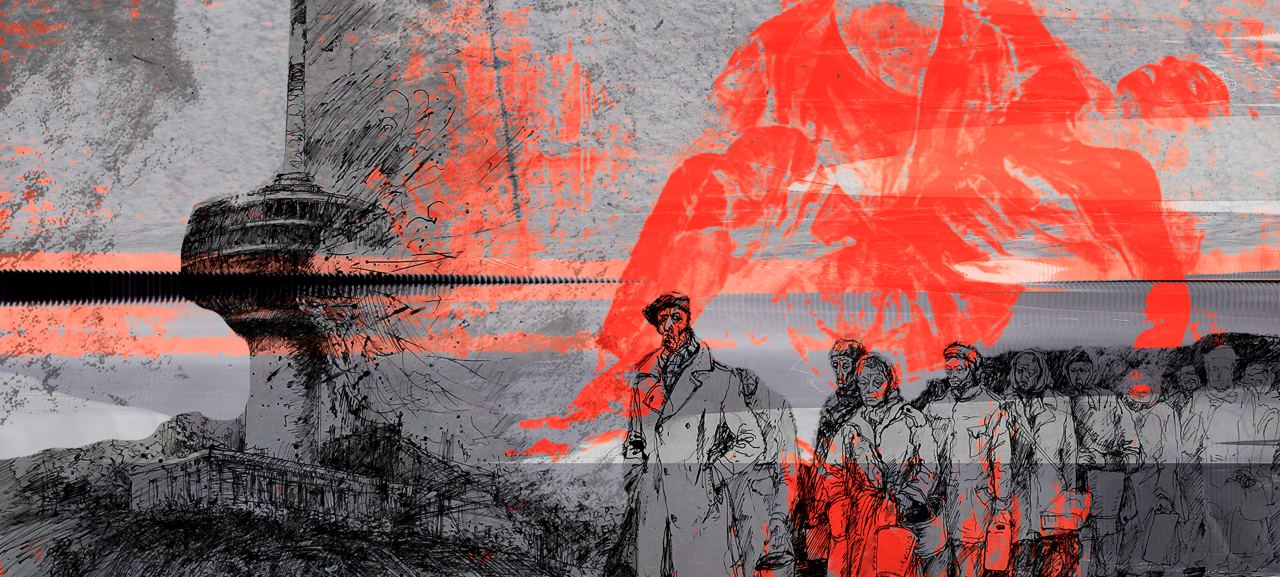
Bosnian art portrays the war as terrifying, painful, and profoundly disfiguring; at the same time, it offers a sharp critique of the “deeply concerned” political community and the organisations that so casually draw lines on maps. Borders, queues for water, the cold-blooded killing of adults and children. These are all present in the Bosnian works selected below. For Ukrainians, these images and performances are unlikely to come as shock content; rather, they serve as a reminder that evil reinvents and repeats itself. A war at the heart of Europe. The 1984 Winter Olympics in Sarajevo, UEFA Euro 2012 in Ukraine. Cities that only a few years ago welcomed hundreds of athletes and millions of fans are now shelled and destroyed on a daily basis. The war can quite literally be followed in real time.
Finding ourselves at the epicentre of evil, our task is to comprehend it, to record our lived experience of endurance and resistance, to preserve evidence, and to speak the truth. Bosnians did this; Ukrainians are doing it; and others will do the same in the future.
Documenting and Reflecting: Art as an Existential Necessity
The war in Bosnia and Herzegovina lasted from 1992 to 1995 and became one of the greatest tragedies of the twentieth century. More than 150,000 people were killed, and over two million were displaced. Driven by religious and ethnic hatred, entire towns and villages were destroyed; hundreds of mosques and churches were ruined and burned1 Malcolm N. Bosnia: A Short History. London : Pan Books, 1994. 360 p..
The siege of the capital lasted 1,425 days. It is the longest siege of a city in modern warfare. During this time, 11,541 people were killed in Sarajevo, including 1,601 children; more than 56,000 were wounded.
According to the Sarajevo Memorial Centre, the city was struck by an average of 329 shells of various calibres each day, with devastating destructive force. On 22 July 1993, Sarajevo endured a record bombardment of 3,777 shells. In total, more than 50,000 tonnes of artillery ammunition were fired on the city during the siege.
Alongside the siege of the capital, one of the most notorious events of the Bosnian War was the Srebrenica massacre. The killing of 8,372 civilians in 1995 became the gravest crime in Europe since the Second World War and was recognised as genocide by the International Criminal Tribunal for the former Yugoslavia in The Hague2 Slika krize. Kulturne i umjetničke prilike u Bosni i Hercegovini 1990–2020 / prired. A. Šljivić, N. Čačković, S. Šarić. Sarajevo: Buybook, 2022. 352 s..
All of these harrowing events left a deep imprint on Bosnian artists and profoundly shaped their work. Art became not only a means of reflecting on and processing collective trauma after the war, but also a way of documenting reality and a therapeutic tool in the midst of it.
In his book Images of Crisis: Cultural and Artistic Possibilities in Bosnia and Herzegovina 1990–20203 Slika krize. Kulturne i umjetničke prilike u Bosni i Hercegovini 1990–2020 / prired. A. Šljivić, N. Čačković, S. Šarić. Sarajevo: Buybook, 2022. 352 s., Irfan Hošić writes that “[…] while the outskirts of the city were encircled by military forces, […] Sarajevo saw a flourishing of social initiatives, art exhibitions, and cultural events as a form of resistance to military occupation, as art became a kind of existential fact and necessity like water, food, and air.”
A similar process unfolded in Ukraine. The initial Russian invasion of Donbas in 2014 sparked an artistic surge, producing works that captured life in the eastern regions both in times of peace and in wartime. For instance, the art book Collective Fantasies and Eastern Resources by Kateryna Aliinyk and Natasha Chychasova emerged during this period, as did Dana Kavelina’s performance depicting a utopian world in which those killed in the war are brought back to life. As in Bosnia, these and thousands of other works in Ukrainian art reflect on themes of the loss of home and the longing to return. Our experiences differ, yet they are close and, tragically, recognisable. What unites them is the war and the shared experience of living through it.
Recognisable Images of War
This article explores several artworks created both during the war in Bosnia and in its aftermath. The range of emotions, sensations and reflections contained within these works offers a deeper understanding of how a city, a state, and a society function under the brutal realities of war. I have chosen to divide the works into two categories, distinguishing between two different approaches through which artists attempted to come to terms with trauma. The first group of works discussed here offers a commentary by Bosnian artists on the (mal)functioning and non-intervention of international organisations. Here we see grand names but little action, dry bureaucracy, and lines drawn on maps as though detached from real life.
The second group focuses on human emotion—fear, the pain of loss, and the horror in the face of the enemy’s atrocities.
When I speak with Bosnians about the war in Ukraine, they nod with a sense of recognition, and the conversation tends to circle back on itself: “It was the same for us—no water, no electricity, except perhaps for a couple of hours,” and then “We just had to wait until something was signed…” Some of the artworks depicting everyday wartime life in Bosnia and Herzegovina remind me of the early days of the full-scale invasion, when I was living in Kyiv, in the Lisovyi masyv (residential neighborhood): the only food left in the Silpo supermarket was condensed milk, and queues at the pharmacy could stretch for three or four hours.
In Bosnian art, queues, water canisters, and various improvised devices that make daily life a little easier or at least bearable are recurring elements in painting, installations, and film.
As for global politics and the role of international organisations, a dynamic emerges that closely mirrors the Ukrainian experience. In the beginning, it seems as though the eyes of the entire world are fixed on your tragedy, and one assumes that if they see us, they will surely help. At first, we rely on that help; later, we come to regard it more as a welcome surprise than an expectation. Eventually, a painful realisation sets in: most people in the so-called West would struggle even to locate our country on a map, and they are by no means ready to boycott aggressor nations simply because those nations have attacked us. This brings us to the first group of works selected for this article. Works…
… Concerned with global politics.
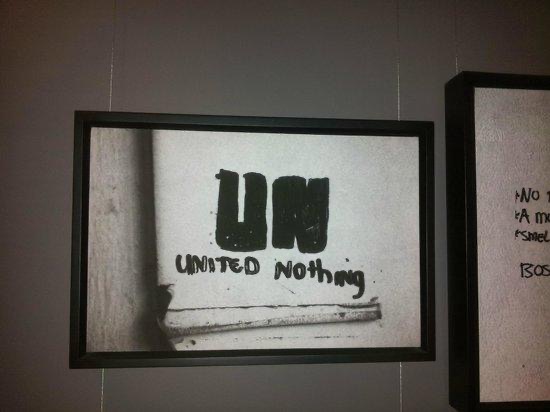
The painting UN—United Nothing is housed in the Srebrenica Genocide Memorial Museum, Galerija 11/07/95. It is a vast, multi-storey space full of interactive exhibits. Visitors can sit at a computer and follow, hour by hour, day by day, how the massacre was prepared and carried out. They can view photographs from exhumations, watch several documentary films, and read the names of all those who were killed.
One of the most striking realisations one carries away after spending three or four hours with the exhibition is that the massacres in Srebrenica were cold-bloodedly planned, executed, and concealed. Afterwards, I found myself thinking, “This was a system that involved thousands of people, those willing to carry out orders, and those who enabled them. There were drivers behind the wheels of buses; there were attendants filling vehicles at petrol stations. Srebrenica is a story of thousands of people acquiescing to what took place.” Exhumations from mass graves continue to this day; families are still searching for their relatives. What I found most frightening was the fact that the remains of a single body could be discovered in different burial sites, five to ten kilometres apart.
I have listened to interviews with Ukrainian women who were held in Russian captivity, and when asked how justice might be restored, they answered, “That every individual be held accountable.” Their names are known, recorded in indictments; their faces are visible in photographs. And history already tells us how the International Criminal Tribunal for the former Yugoslavia concluded its work: 161 individuals indicted, 93 convicted. Yet some families have still not found their executed relatives. So has justice truly been done?
United Nothing sharply conveys the attitude of many Bosnians towards international organisations in general, and the United Nations in particular. In April 1993, Srebrenica was declared a “safe area” under UN protection. Two days later, UNPROFOR (United Nations Protection Force) arrived and began disarming the Bosnian population. The residents of Srebrenica believed they were protected, and that the violence would indeed come to an end4 Memorial Centre Srebrenica.
When I left Galerija 11/07/95, one thought would not leave me: how convenient it is that, instead of preventing genocide as it unfolds, the United Nations invests decades later in high-tech, interactive museums designed to document it in precise detail. And this is not only about the gallery dedicated to Srebrenica: there is also the Siege of Sarajevo Museum, the War Childhood Museum, the Museum of War and Genocide Victims in Mostar and other cities.
Bosnia is by no means an isolated example of the “museumification” of large-scale tragedy. It has happened before, and it will happen again. Ukraine, in all likelihood, will also have its own high-tech museums dedicated to the massacres in Bucha and Mariupol. A war that the world has, in effect, watched unfold online will be even easier than Bosnia’s to reconstruct minute by minute on touchscreen displays.
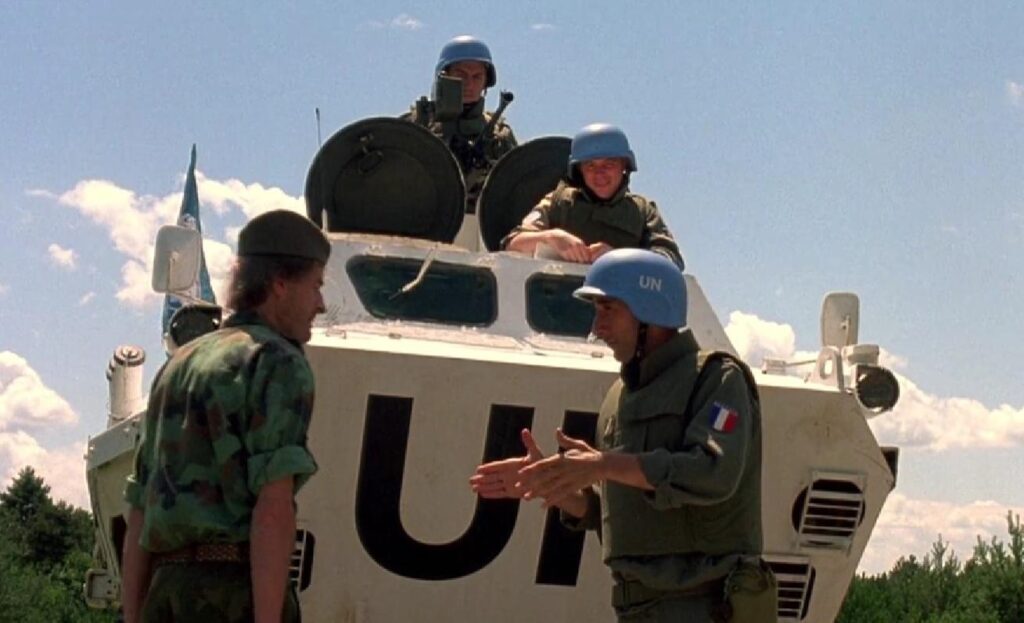
… and internal borders
When the war in Bosnia came to an end with the signing of the Dayton Agreement, borders became another central theme in Bosnian art. Although the country’s external borders remained unchanged, the agreement recognised Republika Srpska as one of the two entities within Bosnia and Herzegovina (though not as an independent state). Later, in 1999, a separate administrative unit—the Brčko District—was also established, formally belonging to both entities while holding a special status.
In Images of Crisis, Irfan Hošić notes,
“[…] in the post-war artistic context, a number of works by artists from Bosnia and Herzegovina emerged that employ state, ethnic, and identity borders or the very notion of the border itself as a means of analysing political attitudes and as a tool for critiquing their construction. By establishing, cultivating, and maintaining visible or invisible borders, ethnic division is sustained, while social vulnerability and economic instability are intensified. On the right of the political spectrum, the border becomes a military trophy, something to be celebrated, debated, and theorised.”5 Hošić, Irfan. Slika krize: kulturne i umjetničke prilike u Bosni i Hercegovini (1990-2020). Bosnia and Herzegovina: Buybook, 2024.
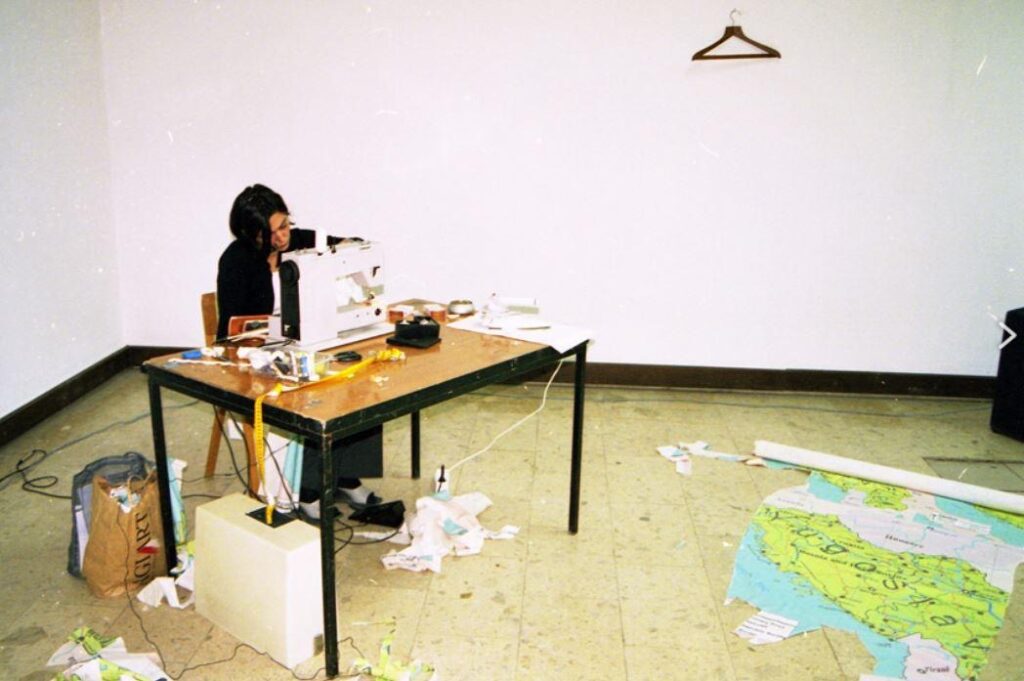
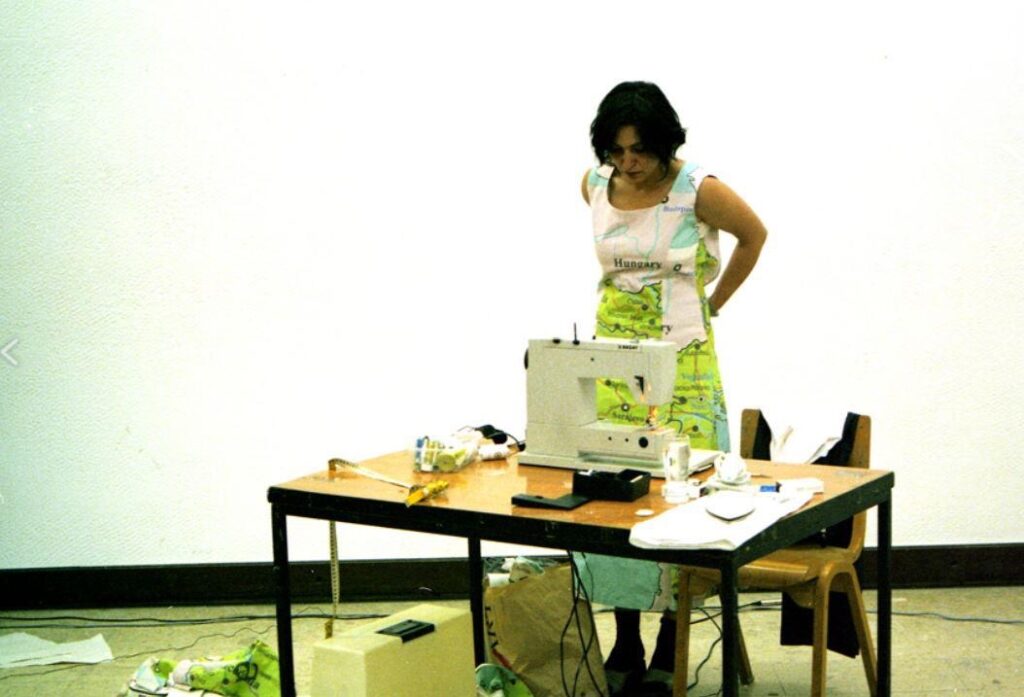
The theme of borders is also explored by Maja Bajević in her 1999 performance Dressed Up. Over the course of seven hours, the artist sewed a dress from a map of Yugoslavia, then put it on and concluded the performance by silently walking away.
The choice of garment itself is telling. A dress carries a distinctly gendered connotation. It is neither a trouser suit, nor outerwear, nor a military uniform. No matter how states and territories are redrawn, no matter how shells tear through city streets, a woman is still expected to wear a dress—a gendered norm that stands in stark contrast to the equally reductive notion that “boys are meant to fight.”
The pliability of fabric, and the very idea that a dress can be tailored to fit anyone, may also be read metaphorically: any political force can take a pattern and stitch together a state of its own.
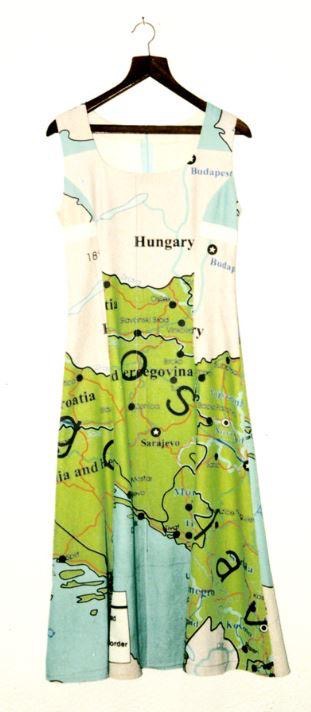
Even the very act of cutting fabric with sharp scissors, the separation of a single piece of cloth, I read as a symbol of cruelty, of violent intervention, of something unnatural and traumatic. Scissors can wound, and one can just as easily wound oneself: a cut inevitably draws blood in the process of “reshaping.” The same applies to handling a needle, which can prick the skin or leave such a painful blister that one’s fingers ache for days.
This leads me to reflect on how hours of sewing might have affected the artist’s own body: the fatigue of prolonged work at a sewing machine, the pain in the hands from handling sharp tools. This becomes a kind of bodily echo of injury and chronic illnesses, reflecting the consequences of a war fought over “the reshaping” of borders, the burden of which fell on thousands of Bosnian men and women.
Sewing itself can also be read symbolically. Stitching one piece to another seems to suggest that these fragments do not wish to hold together of their own accord, yet are made to do so, forced, fixed into a single structure.
Another work engaging with this theme is Border (2010) by Borjana Mrđa.
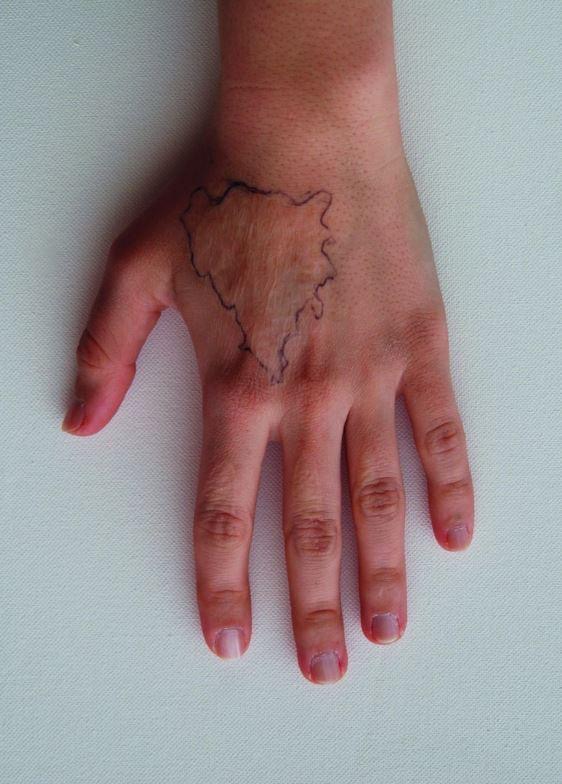
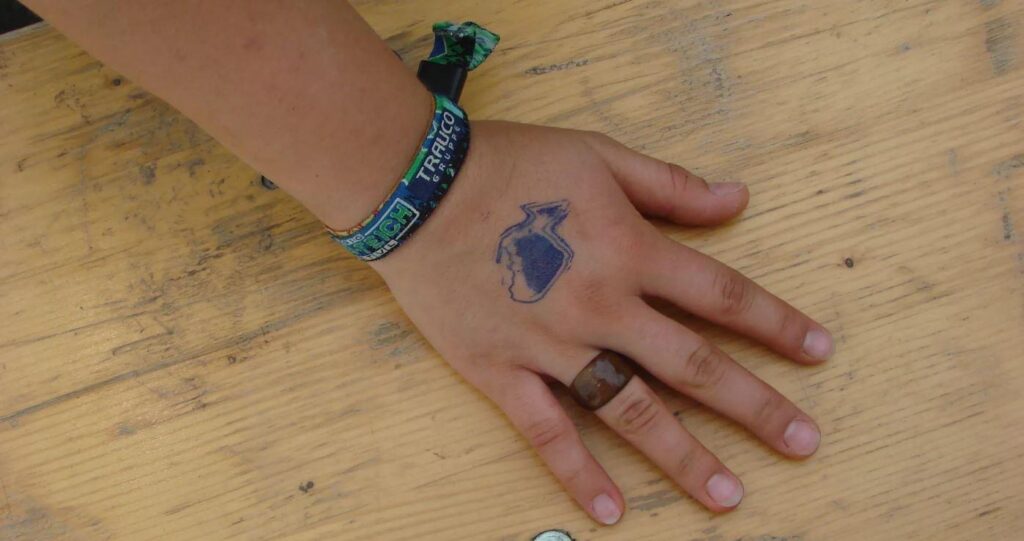
The artist recounts how she drew a map of Bosnia and Herzegovina over a scar she had carried since childhood, adjusting its contours directly on her skin with a pen, noting that the scar itself changes and gradually fades over time6 Borjana Mrđa, Granica, 2010.
The childhood scar becomes a symbol of injury, damage, an old trauma. The map of Bosnia appears almost as an attempt to conceal this wound, to cover it so densely that what lies beneath becomes obscured: fragmentation, aggression, the absence of a unified direction for the state, the unresolved trauma of war, and forgotten veterans. The childhood scar as something unsightly, something to be hidden. Perhaps the drawing of borders might heal it?
Beyond the dynamic of “wound and healing,” the work also presents state borders as something inherently unstable. It raises the question of permanence: the trace of a pen can be easily washed away, or simply rubbed off. Unlike a tattoo, which grows with the body, borders drawn in ink can be redrawn at any moment or erased as though they had never existed.
The Ukrainian artist Vlada Ralko voices similar reflections on the relationship between the body and the state. She emphasises that the human body has always known pain, but that this experience has now reached an extreme, as Ukrainians are taken captive, subjected to torture, or wounded in war.
“If we consider ourselves human, we cannot separate the mortality and pain of our own body or that of our family from the mortality and pain of the political body, where suffering and death arise not from illness or the natural cycle of life, but from injustice.”
Returning to the performances of Bosnian women artists that engage with the body and the state, it is worth noting that, within a gendered framework, bodily change is rarely perceived as positive. Rather, it is often understood as a continuous loss of youth, energy, reproductive capacity, and so on. One might read this as follows: anxiety about the loss of certain physical attributes is equated with anxiety about the loss of the attributes of the state or of the state itself.
This anxiety is bound up with a foreboding sense of what may come. According to some estimates, during the war in Bosnia and Herzegovina, Serbian forces raped around 20,000 women and men; other sources place the figure as high as 50,000. The loss of borders, cities, and the state itself is inseparable from the loss of sovereignty over one’s own body. It comes to belong to whichever army has taken control.
…the horrors of war
The second group of works depicts the anxiety of loss, loss itself and its processing, the horrors of war, besieged cities, and the realities of genocide.
Let us turn to the drawings of Mevludin Ekmečić.
People shot dead, ruined buildings, ambulances, queues of civilians carrying water canisters. These stark realities of the Bosnian war emerge in Ekmečić’s work through strictly black-and-white sketches that appear almost hurried. Yet they are skilfully rendered and highly detailed.
The bodies of the dead lying on roads, their belongings scattered, bags with their contents spilled out, wedding rings still on their fingers, and all the other traces of lives once lived, recall the harrowing details seen in photographs from the massacre in Bucha or the aftermath of shelling in residential neighbourhoods. From shattered buildings and apartments, furniture and personal possessions are strewn across the open space. A photograph of a kitchen cupboard that somehow remained fixed to the wall of a bombed-out building drew the attention of leading international media outlets. It seemed, at the time, that now, having witnessed such atrocities, the world would respond with decisive action. And yet, instead of anger or genuine empathy, viewers watching in real time often applauded Ukrainian “optimism” and resilience.
This, once again, leads to the thought that reliance on outside help should not be overstated. Such meticulous documentation of war becomes another means of pursuing justice independently, of preserving evidence. It resembles an almost obsessive need to keep proof of atrocities close at hand, just in case anyone asks.
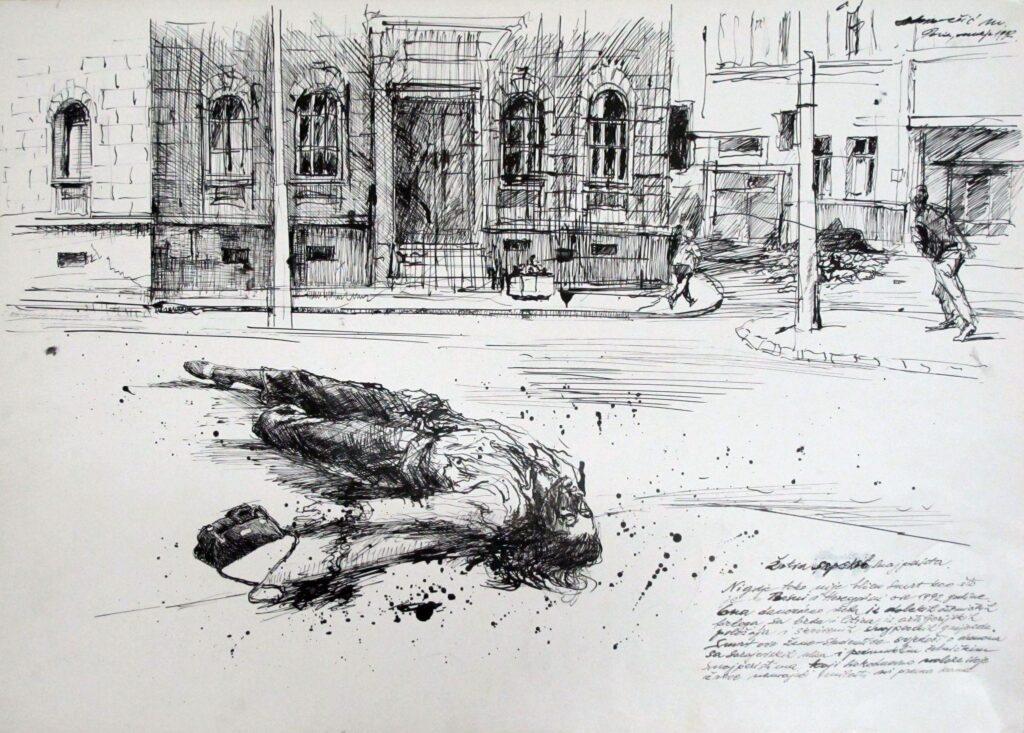
The drawing featuring a wheelbarrow echoes a story from besieged Sarajevo, recounted by Ozren Kebo in Sarajevo for Beginners. In the chapter “The First Snow,” he describes how, one winter, a father went outside with his young son, no more than three years old. The child begs his father to push him in a wheelbarrow through the snow; the boy “screams with joy as the man pushes it along.”
“Two little girls watch them pass from a window. They smile at the boy, but their smiles are sad. […] There is only one detail missing to make the scene truly Sarajevo-like. A sniper. He will appear in a minute and a half… and pull the trigger without emotion. The shot will throw the boy from the wheelbarrow and take his head off. The father will stand in stunned silence.”7 Kebo O. Sarajevo: A Beginner’s Guide / trans. from Bosnian by E. Elias-Bursać. Sarajevo : Buybook, 2005. 162 p.
The postures of living figures in the paintings are almost always highly dynamic. From the drawings alone, one immediately senses that one cannot simply walk down the street. You have to move in short bursts from cover to cover in order to get anywhere alive.
The realities of moving through streets during wartime are carefully reconstructed in the short film 10 Minutes by director Ahmed Imamović. The title is subtly reframed in a brief philosophical exchange at the beginning. In the post-war present, one of the characters enters a photo studio and asks to have his photographs printed. The photographer tells him it will take ten minutes, to which the client replies, “How can such an important and responsible task be completed in such a short time?”
The film then shifts into a memory of a teenager whose mother sends him out with water canisters, just as shelling begins. The director makes it clear to the viewer that ten minutes is enough not only to print photographs. In that time, one might manage to survive or to die.
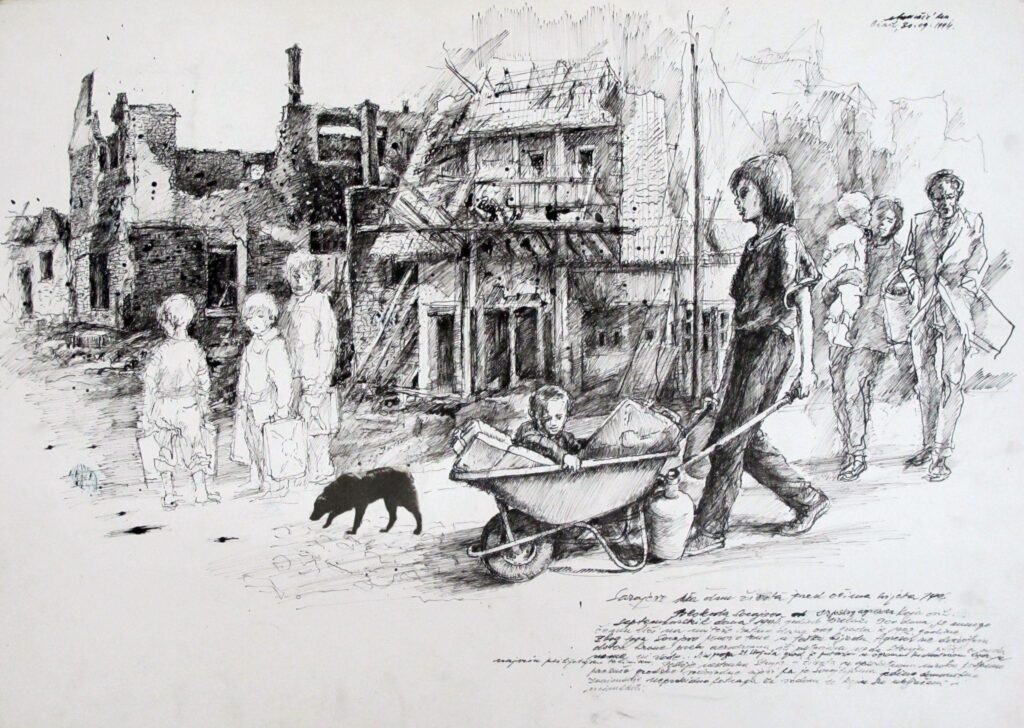
Another image that captures the frustration and precariousness of life in a partially destroyed city is that of a queue for water. Some people hold canisters, others buckets; they are exhausted, their gazes fixed on the ground.
In the same book, Ozren Kebo writes, “Do we deserve water? Yes, we do. What is the sweetest sip of water? The one that is deserved. And therefore, the sweetest water is that from a canister.”
The theme of the sip as a basic unit also appears in Aida Šehović’s performance Što te nema (“Why Are You Not Here”).
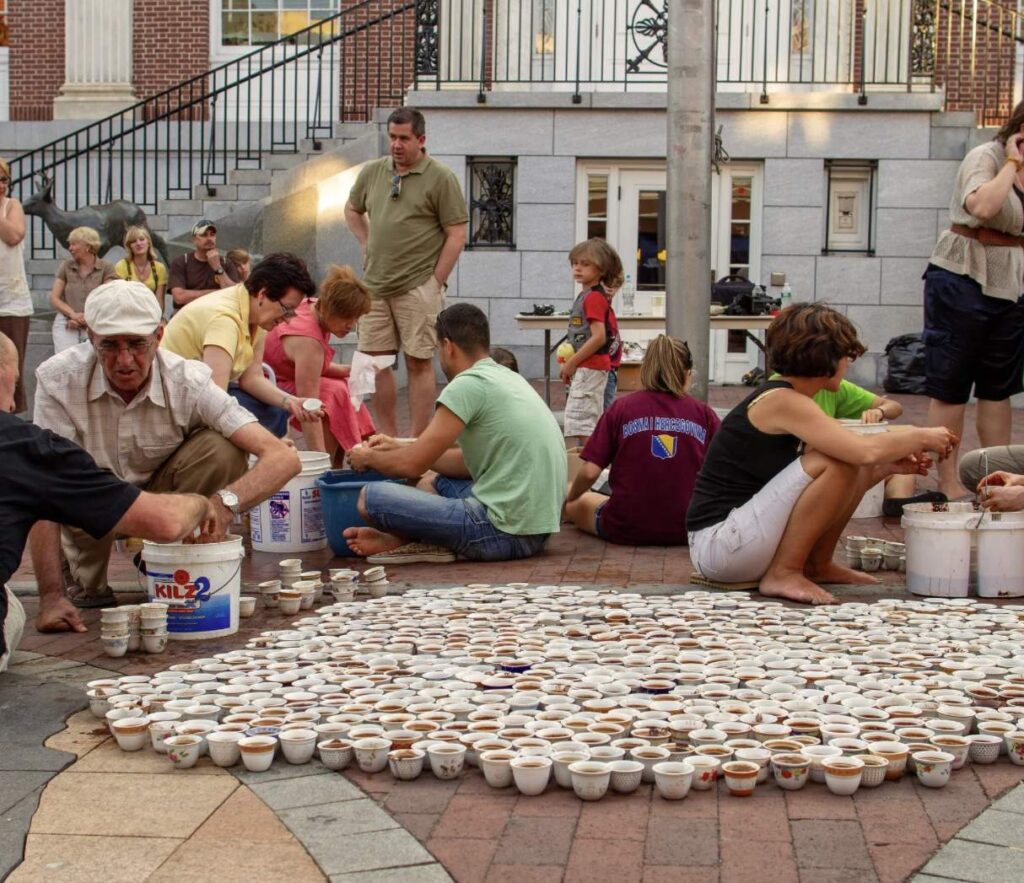
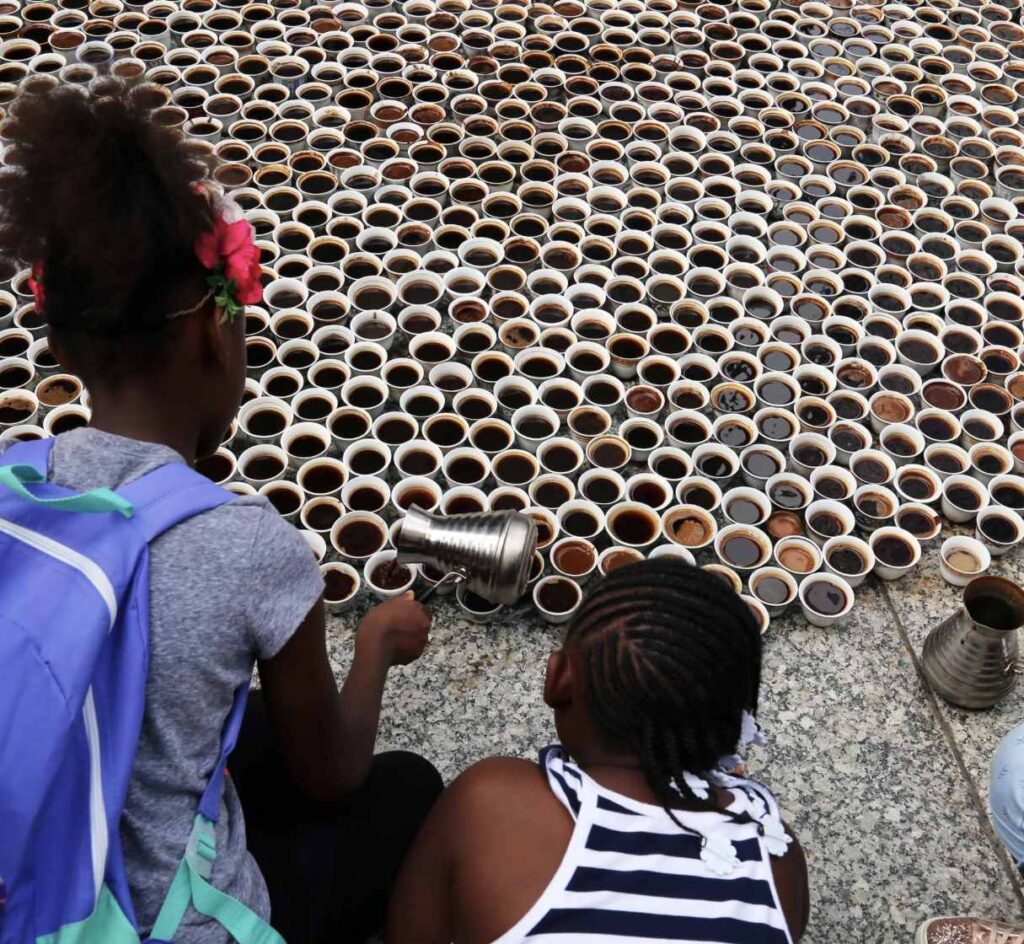
For this work, the artist collected more than 8,000 coffee cups to commemorate the victims of the Srebrenica killings. Some of the cups belonged to the victims themselves; whilst others were given by their families. In various ways, Aida Šehović assembled 8,372 cups—the official number of those killed in Srebrenica.
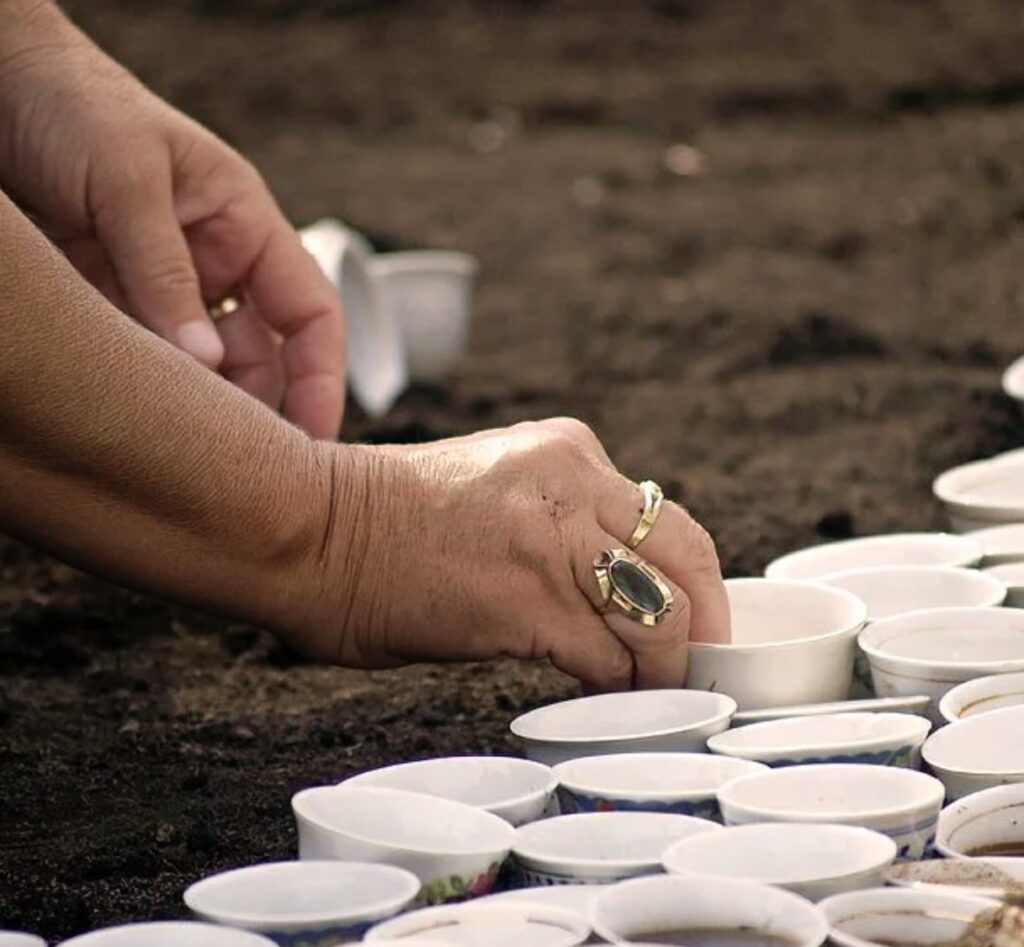
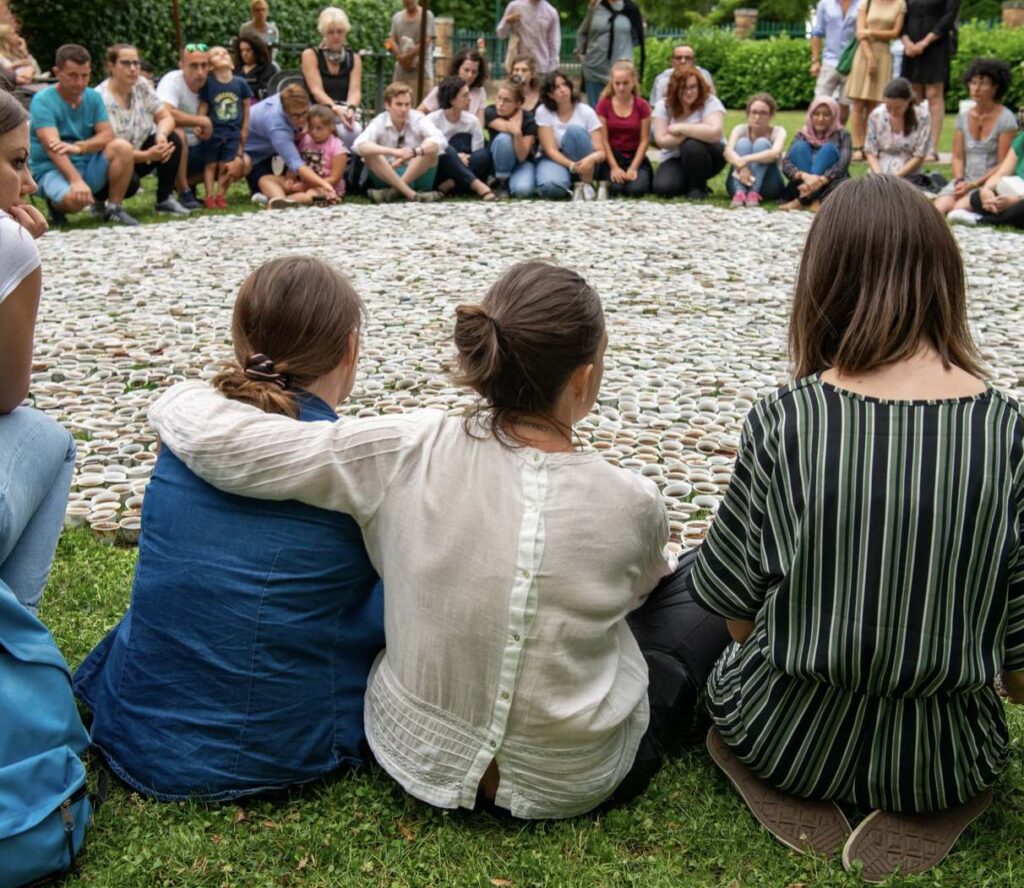
The performance has been staged in various cities across Bosnia and Europe, but most significantly, in 2020 it was presented in Srebrenica itself. The artist placed the cups precisely on the site where men had been forcibly separated from women and taken away to be executed.
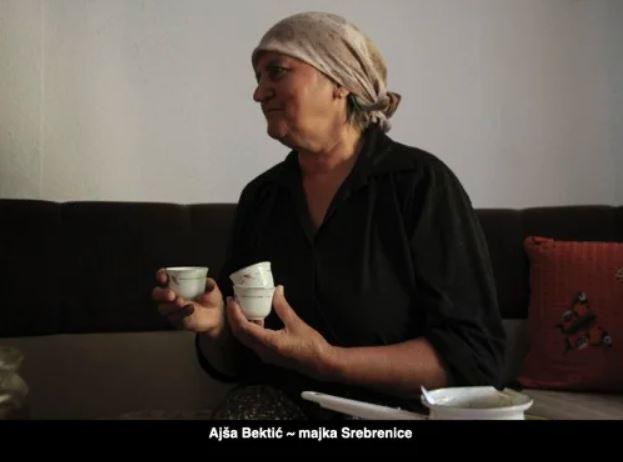
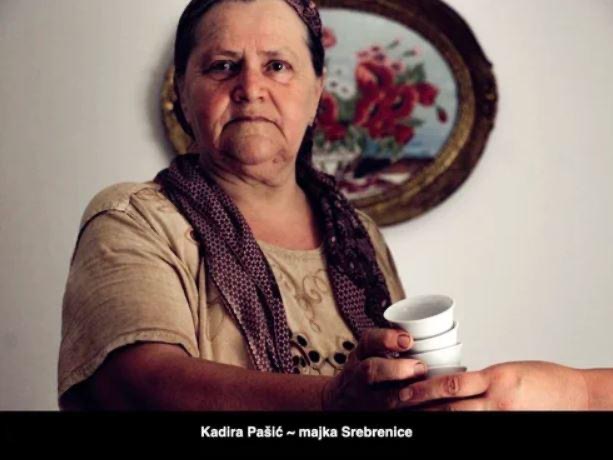
Commenting on the work, Aida Šehović notes that the coffee cups commemorating the victims revive the ritual of shared coffee drinking. She emphasizes, “We do not drink coffee from such cups when we sit alone in front of a computer. Shared coffee is intended for the exchange of experience and conversation.” In this way, the gesture preserves and continually re-enacts a vital part of Bosnian identity, the very identity that the genocide sought to erase.
Bosnian coffee is drunk for at least an hour. It is not a shot of espresso that you drink quickly while rushing to work. It is a way of slowing down, of savouring taste and company, and, as Aida Šehović emphasizes, experience and conversation. By reviving this ritual in Srebrenica together with the families of the victims, the performance seems to say, “You can destroy everything, but not the way we drink coffee together.”
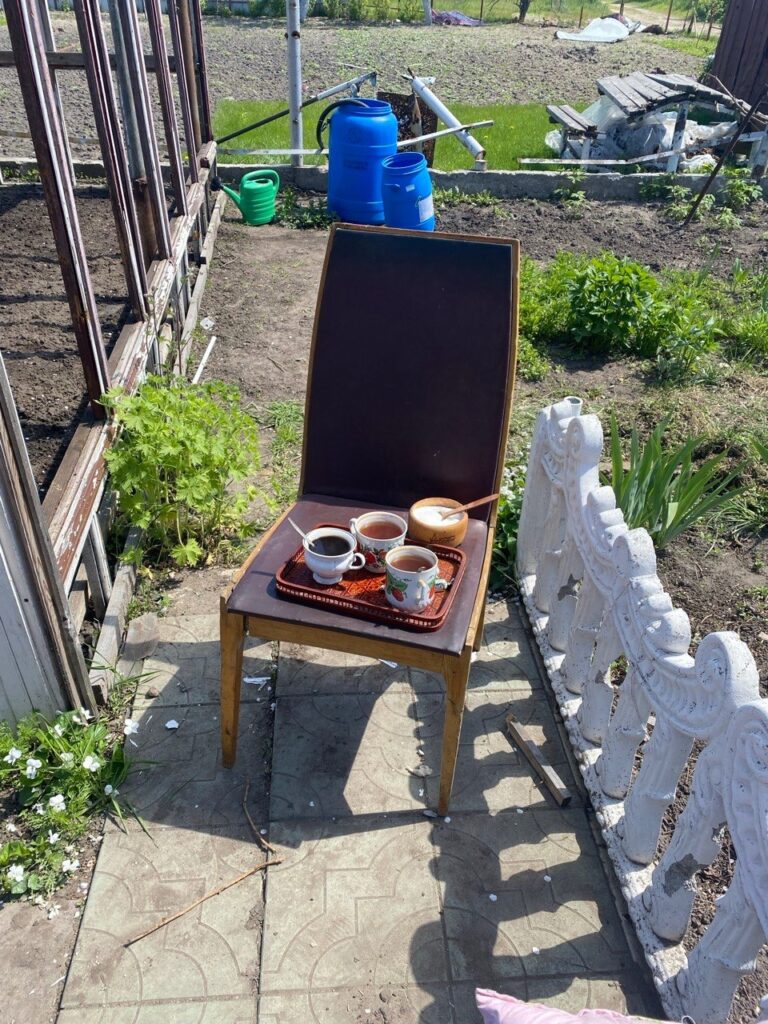
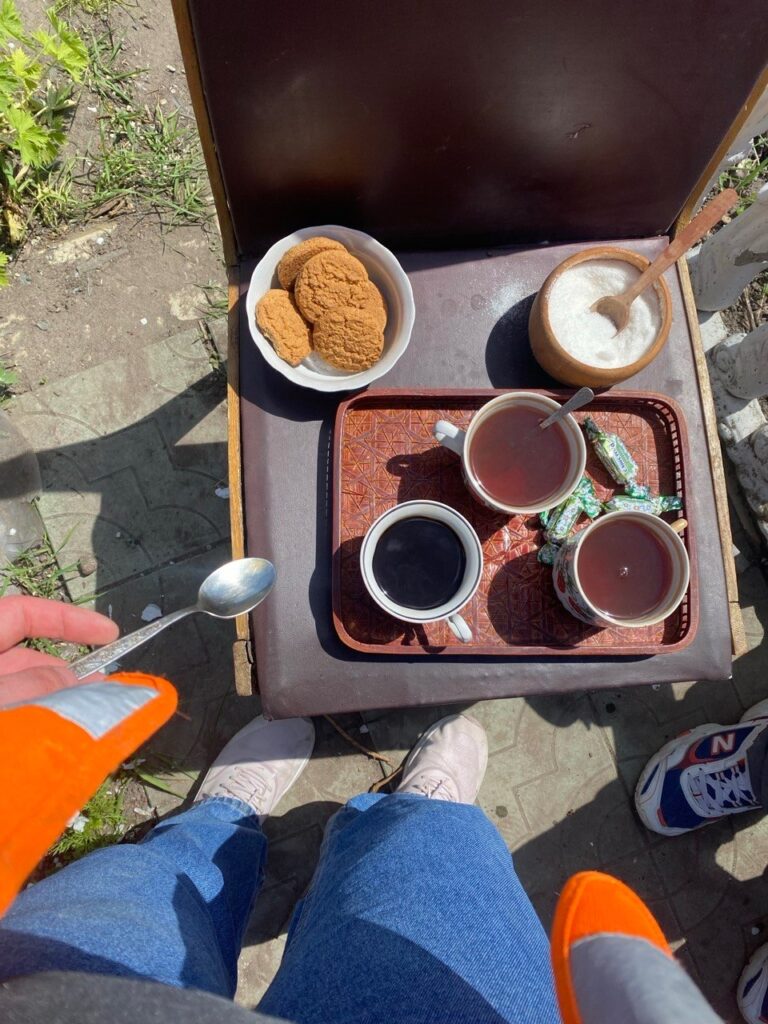
When I volunteered in 2022 in villages destroyed in the Kyiv region, our team was repairing roofs and clearing rubble in Hostomel. In the village of Horenka, a woman whose house we were restoring brought us coffee, oat biscuits, and “Romashka” sweets (named after chamomile).
While living through the loss of her home and mourning her neighbours, she—like the mothers of Srebrenica—continued the ritual of preparing and sharing coffee. In Bosnia, it is not customary to serve coffee on its own; in cafés, a piece of lokum is always placed on the tray. The same is true in Ukraine. And so the woman from Horenka, even while finding herself in the midst of death and destruction, continued to observe the rituals of hospitality, offering sweets and biscuits, because that is what is customary and what feels right.
Exit
Finally, there is Bosnia’s most renowned artist, Safet Zec. His works feel like a summation of everything that has been said, made, and endured. The series Exit consists of thirteen paintings dedicated to the experience of death and loss.
The title Exit refers to the biblical story of the final plague in Egypt. When Pharaoh refused to release the Hebrew people from slavery, the last of the ten plagues sent by God was the death of the firstborn in every Egyptian household. It is important to understand that this does not refer only to infants, but to all firstborn sons in the family—boys, grown men, and elderly men alike. Exodus 12:30 reads: “[…] and there was a great cry in Egypt, for there was not a house where there was not one dead.”
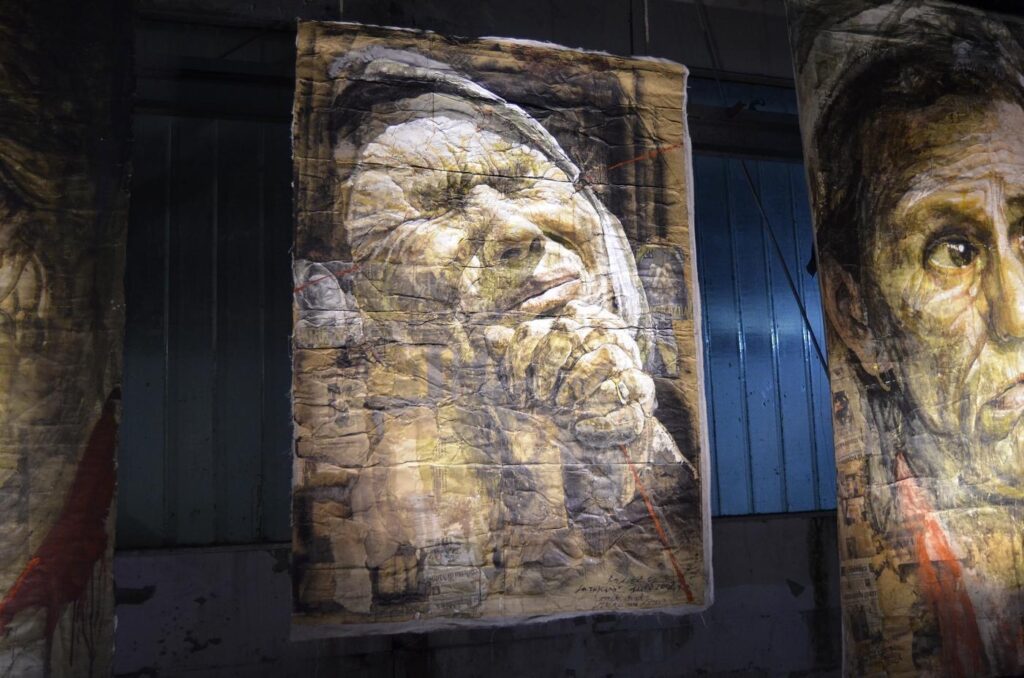
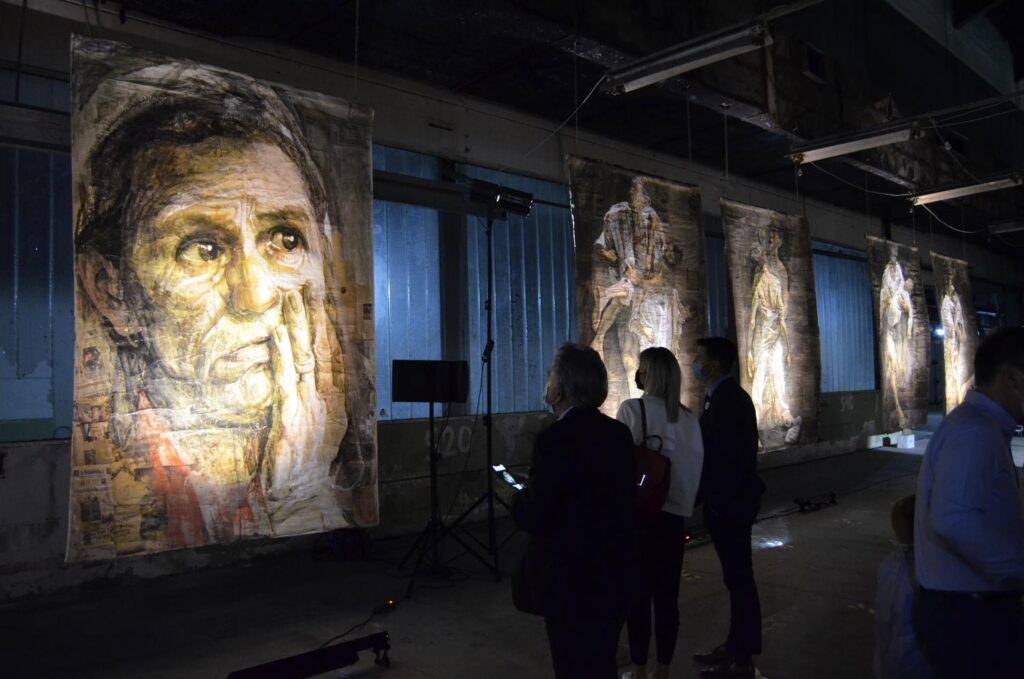
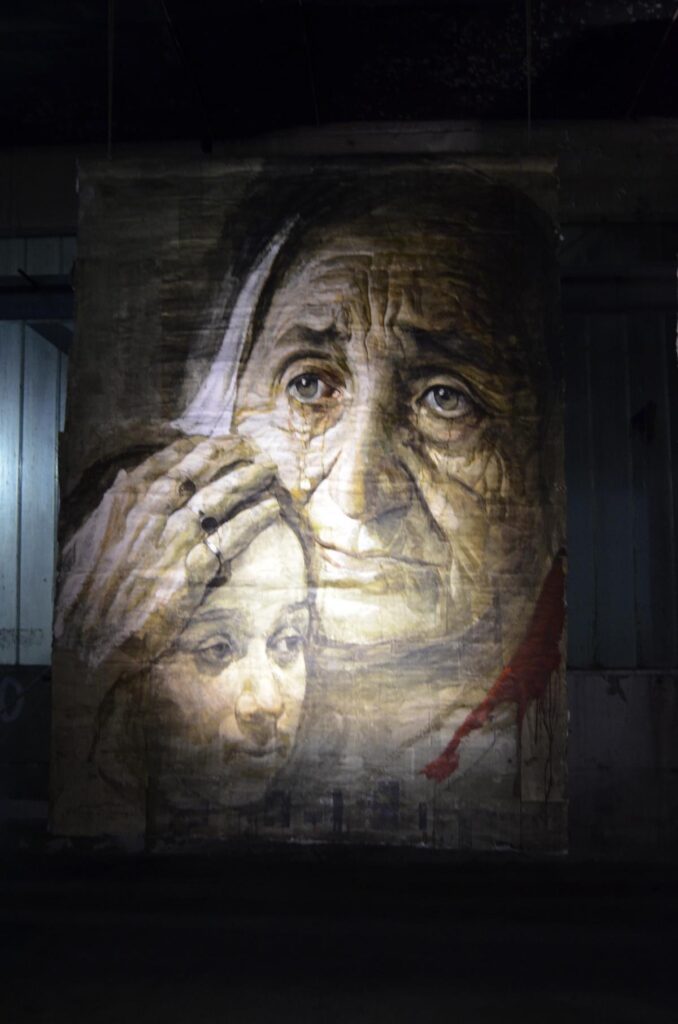
In these well-known paintings, women whose bodies and faces are distorted by suffering are shown in a silent cry that cannot be released. The artist seems to take us into those Egyptian homes on the night when the Angel of the Lord passed through Egypt and took the firstborn. The women depicted are no longer young: Zec renders every wrinkle on every face in detail—a trace of thoughtfulness, past laughter, and surprise. All that remains of their past emotions are empty, numb, tear-filled eyes.
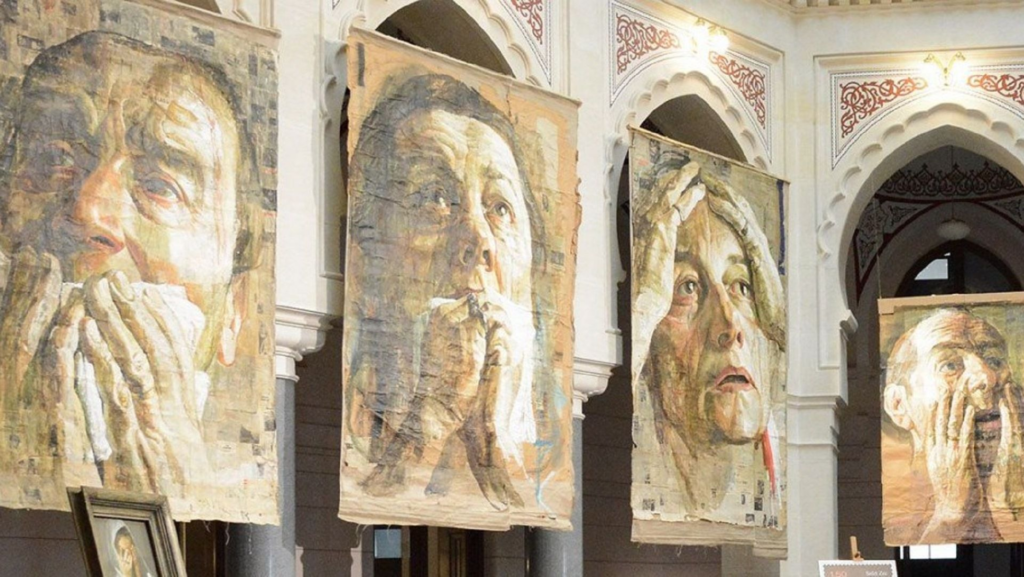
The protagonists are mostly older women. This suggests they are mothers mourning their executed sons. Yet in one painting we also see a male face, which introduces another layer of grief, that of survivor’s guilt. If every family has lost a son or husband, a question inevitably arises, “Why mine, and not hers?” and, for the survivor, “Why them, and not me?”
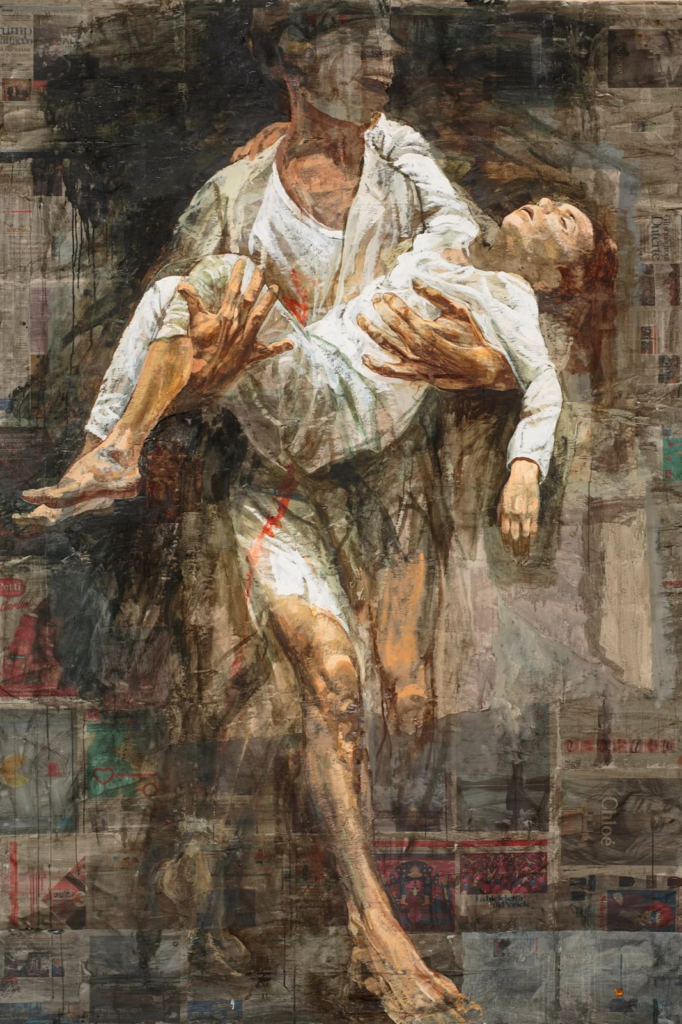
And once again, the figures in the paintings are running somewhere. Once again there are these short bursts of movement, once again there is only ten minutes in which to manage to survive or to die. And although the boy’s body on the canvas appears limp, the first assumption is that he is already dead.
Reportage photographs from any Ukrainian city would confirm this impression. When Russian forces shelled Mariupol in 2022, news photographs showed a father running into a hospital carrying an 18-month-old child in his arms. The same dynamic posture, the same sense of chaos, and the same limpness of the child’s body in the arms of a distressed man. That child did not survive.
Yet when looking at Safet Zec’s painting, one notices that he hardly depicts blood. The boy’s wound is not shown; instead, there are only white shirts, white trousers, and shorts. From the father’s left chest runs a thin, barely visible red line, but to me it is not about physical injury. It is about emotional pain seeping out of the body, while one still keeps running, functioning at the limits of endurance, ignoring everything else because there are things that must be done first: getting to the hospital. We might still make it.
It is striking that the boy’s face is rendered realistically, while his father’s seems to merge with the background. The surface of the painting almost reads like magazine covers and newspaper pages; one can make out the name of the fashion house Chloé. In capitalism, even premium handbags and shoes must be advertised while the war is unfolding and snipers are shooting. Perhaps, if these people survive, they will celebrate life by buying new perfumes. The father’s face also resembles a newspaper clipping. His mouth is open, his teeth visible, he is screaming. He is not looking at us but away, searching for help.
We might still make it.
Yet what remains unsettling is how clean the characters’ clothes are, almost glowing through the painting, as they leave a chaotic, indistinct background behind them and move towards the viewer. As the father carries the child, his leg seems about to break out of the frame and step beyond its edges—towards us.
And that means there is still a chance for help and for rescue.