
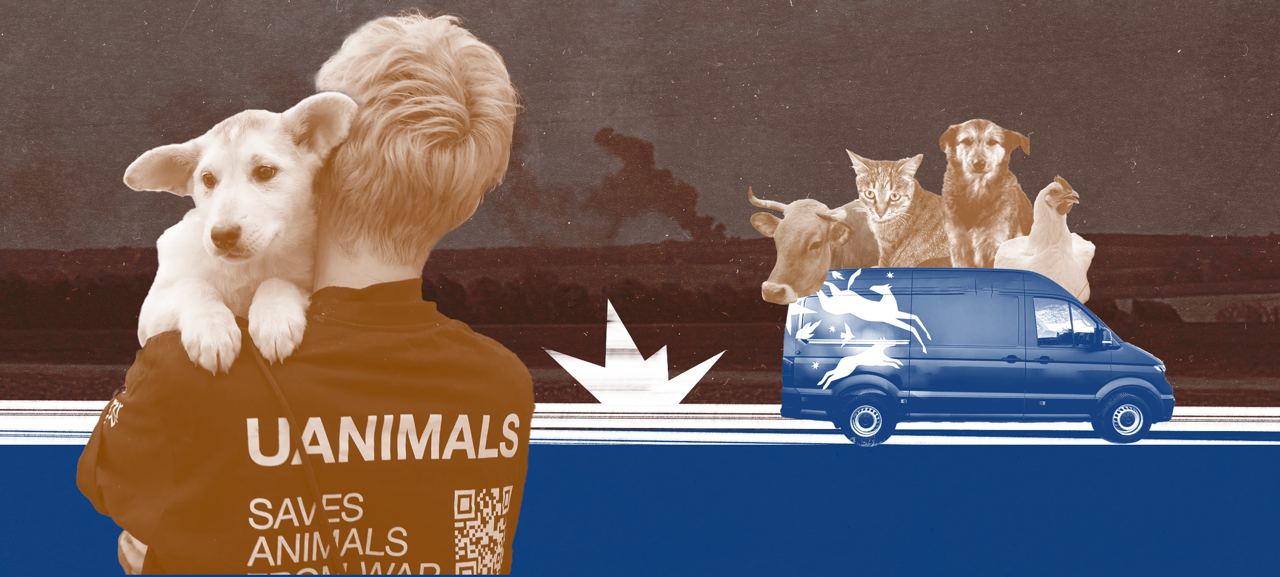
A cat pulled from the rubble after a twelve-hour rescue operation, a dog and its owner trapped together under concrete slabs after a Russian missile strike, an elderly couple carrying what their worn-out carts could bear, leading two cows along a death road for dozens of kilometers from Kostiantynivka – alongside the reports of dead and wounded – this is what Ukrainian media broadcast every day.
People, despite their own tragic existential situation taking in lost, stray animals, are a common sight in towns and villages teetering on the edge of life and death. Soldiers taking in lonely cats and dogs into their dugouts.
To some, it might seem like a sentimental wartime detail, but in reality, it is the core of the war – proof that this war is fought over more than territory – over humanity itself. It’s hard to defeat a society like this.
Even if tactical effects are achieved on the front through immense effort, they still do not translate into a strategic breakthrough in diplomacy that would allow Russia to dictate peace solely on the aggressor’s terms, as modern war is also fought within society – its cohesion and its willingness to support the army and the most vulnerable.
Among Ukrainians, there is a quiet tension between condemning and understanding those avoiding mobilization. We should go to the front – but no one wants to die. This is not a contradiction, but proof they have not lost the human dimension of this struggle.

More on that a few hundred kilometers ahead…
Vlad couldn’t sleep the night before the departure for the evac mission. His dog barked through most of the night at the missile strikes and air-raid alarms in Kyiv. From the night of February 2nd to 3rd, Russia launched around 71 cruise and ballistic missiles and 450 drones from the direction of Ukraine. Many of them were aimed at the capital.Early February brought biting cold and widespread blackouts in Kyiv, with around 60 percent of the city left without electricity, heating, or water as indoor temperatures barely rose above freezing.Vlad’s apartment was also left without power and hot water. The cause was repeated Russian attacks on Ukraine’s energy and heating infrastructure.
Vlad is 29. For two years he has worked with UAnimals – a Ukrainian organization evacuating animals from frontline towns and providing them aid. Most often, he drives to the Donbas.
– I know the roads of Donbas better than the streets of Kyiv. – Vlad says with a smile.
On his phone are photos and dozens of map points: villages that no longer exist, streets ending in bomb craters.
– Most of our requests come from Donetsk and Zaporizhzhia region. That’s where the front moves fastest, and the situation for animals changes violently.
When residents decide to leave, for a lot of them securing their animals is one of their first concerns – and if they cannot take them or place them in safe places, they often don’t want to evacuate even from the most difficult locations.
Each month, UAnimals evacuate around 200-250 animals. Mostly dogs and cats. Occasionally, there are horses, cows, goats – then larger transport and cooperation with other organizations are needed. Requests come from owners, from people feeding stray animals or from volunteers. And from the military.
– Soldiers often call us when they find a dog. – says Nina, the evacuation coordinator, over the phone. – They take the dog. Feed it, give it a name, care for it. And when they receive orders to relocate and cannot, for obvious reasons, take it with them, they look for a place for it. That’s when we step in. Dogs from soldiers are always in the best condition.
On the way, a second crew member joins us – Gennadii. A man from Kharkiv, approaching sixty. He currently lives in Kyiv. His apartment in Saltivka, the northeastern district of Kharkiv, was bombed in August 2022.
He pulls out his phone and shows a videos. A few days after the attack, he went to his apartment to see if anything could still be saved. The camera shakes. In the frame: shattered windows, a charred stairwell, burnt-out apartment interiors. Silence, broken only by the wind and his footsteps on broken glass.
His family moved to Kyiv. He joined the Armed Forces of Ukraine. He became a tank gunner – the very same specialization he had back in the Soviet era, when he was stationed in Siberia. After some time, due to health reasons, he was moved to the reserve. He didn’t want to sit idle and became a volunteer evacuating civilians from Kharkiv Oblast, later joining the UAnimals team in August 2025. From a tank, he moved into a van filled with animal carriers.
– People, after all, have a much better chance of survival, they have some possibility to leave. Animals don’t. They’re lost, they don’t know what’s happening. They can’t leave on their own – says Gennadii.

You have to be ready for that
I am joining an evacuation mission from Komyshuvakha in Zaporizhzhia Oblast. We are to evacuate 60 cats and 13 dogs. Today, the village is located about 13 kilometers from Russian positions. It is regularly bombed and watched by deadly Russian FPV drones.
After most residents left, care for the animals was taken on by Natasha – together with her husband and mother. In addition to their own dogs and cats, they fed those left behind without humans. She and her family have found a house with a large surrounding area in central Ukraine. They are setting up a small shelter there. They will leave Komyshuvakha on the same day we take the last animal. It will be a new home for all of them.
The van we travel in is filled with empty cages – large kennels and smaller carriers. Metal scrapes against metal with every turn. Vlad and Gennadii know exactly how many animals will fit inside. We stop just before Zaporizhzhia to arrange everything, on the roadside, methodically. Each cage and carrier is lined with straw and pads. First the larger kennels, then the smaller ones, so they can be quickly removed on site without wasting time.
– We often transport animals together if they tolerate each other. A mother with her kittens, dogs from the same yard. This way we can take more – Vlad says, sliding another carrier into place.
The cargo space begins to resemble a precise puzzle. It smells of straw and cold metal. Large kennels have entrances in the front and side; smaller ones go on top. Every piece must fit together. Cable ties snap tight with a short click and the carriers lock against each other, forming a compact structure.
– It’s like Lego – he smiles. – Everything has to be stable and secured so that nothing happens during the ride.
I ask about the most unusual evacuations.
Vlad starts listing: an ostrich, a raccoon from Donetsk Oblast, pigs from one resident.
– The ostrich was tough. He could swing those big feet or hit you with his head, – he says. – And there were pigs, 150 kilograms each.
He laughs, but immediately begins gesturing, showing how it went.
– With the pigs, you need good technique. They look big and clumsy, but if you approach them correctly, it goes smoothly. First, you guide them from behind, lift their front legs so they can get onto a ramp in the van. Then you guide them from the front, and that’s it, – he adds. – There were chickens, rams, goats. Once, I even evacuated a horse from Kherson.
Gennadii adds his own story.
– We had a dog, about 90 kilograms. Luckily, he was calm, otherwise it wouldn’t have worked. He just lay down and didn’t want to move. We carried him into a kennel in the vehicle, and it was fine.
He pauses for a moment.
– Animals’ psyche after strikes is different. They sense danger earlier than humans. Cats usually handle it much better than dogs; they’re calmer. If you calm them, pet them, it’s fine. Dogs are harder, they feel it more intensely. With heavy shelling, their psyche can break. When we arrive – strangers, movement, noise – stress can erupt. Sometimes they’re aggressive. But it’s not the animals’ fault, it’s the people striking with rockets – Russians.

I ask about farm animals.
– People love these animals just like dogs and cats, so when they have to leave, they try to take them with them. If they can’t, we find them a new place. Often, the decision to send your animals from your farm to another location is one of the hardest decisions for them.
The phone rings. It’s the evac coordinator. There’s another request: 30 cats and 8 dogs from the Zaporizhzhia region. After Komyshuvakha, we’ll continue on.
– The mission plan almost always changes – they say. – You have to be ready for that.
In addition to cages and transporters, the car is equipped with bulletproof vests, helmets, IFAK (first aid kits), and tourniquets. A REB system for jamming drone radio signals is mounted on the roof. They also have a Chuika (Чуйка), a device that detects the radio signals transmitted by FPV drones and displays the live video feed from their onboard cameras. In places where the front line is not a line on a map but everyday reality, such equipment is not an accessory but a condition for survival. Here, every road is under constant surveillance. The eyes of drones hang over roads and towns, ready to attack the first target they spot – a military pickup truck, a civilian car, a man riding a bicycle to buy bread.
On December 12 2025, in Druzhkivka, a town in the Donetsk region currently located about 13 kilometers from the front line, their car was attacked by FPV drone during an evacuation mission. Vlad was a driver, while Gennadii sat next to him, watching the sky and the detector.
– At the last moment, I saw the drone flying straight at us – Vlad says. – I stopped. We ran out.
The car burned completely. It was an FPV drone on a fiber-optic link – not controlled by radio signals. You can’t jam it with a REB or detect it with the Чуйка. Locals later said it was a “zhdun” [from the word ждати – to wait] – a drone perched on the roof of a building, lying in ambush.
– Luckily, it was just the start of the evacuation, only two dogs were in the van. God forbid it had been full… – says Gennadii, adding that they ran out with the dogs.
– After the strike, two more drones were circling above us – adds Vlad. – There was only reception in a few places. We’d run out to make a call and return to cover. The soldiers helped us get out of there – they took us and the dogs.
It wasn’t the first time. Last year, near Rodynske, also in Donetsk Oblast, an FPV drone hit the hood of the same vehicle we’re now driving. The car was repaired.
The drive to Zaporizhzhia from Kyiv takes about eight hours – long enough to talk, to fall silent, and to go through Vlad’s playlists.
They speak of destroyed towns, of beautiful dogs rescued from the rubble of their owners’ homes, of cats found in basements – all to AC/DC and Scorpions. Then Bon Jovi, System of a Down, Linkin Park. Above the road, a strangely red moon hangs in the sky. The music changes faster than the landscape.
We pass another checkpoint, a mobile police control post, and the ТЦК. (Territorial Recruitment Center, the institution responsible for military registration and mobilization). Clearance. A brief glance toward the marked evacuation vehicle.
– Sometimes they wave us through. Sometimes they ask where we’re going and why and in the end, they wish us luck.
I ask about the ТЦК and mobilization.
– It doesn’t apply to me, I’m in the reserve – says Gennadii. – But it does apply to Vlad.
AC/DC ends on the playlist, and something lighter starts, some kind of “radio” song. Vlad turns down the music.
– There’s no protection – he says. – Last year, they took two guys from our foundation.
The first one was at the end of a mission in western Ukraine. He was supposed to deliver animals to a new home. They stopped the car and took him.
– He was devastated. His brother had been killed in the war shortly before.
The second one was taken from the veterinary clinic, where evacuated animals were being sterilised.
The music continues to play.

25 minutes both ways
Gennadii calls Anna, a local volunteer, who knows the current situation, the people in Komyshuvakha and in regard to safety reasons, she works with the military.
– Seven in the morning, on the road, she’ll send us a pin – the location where we’ll meet. Anna has a few of her own cages, we’ll swap them on the spot. We need to prepare a larger kennel for the dog with cancer. Her lower abdomen hurts, she doesn’t like being touched by strangers. She also has mixed feelings about other dogs – he summarizes the conversation.
The landscape outside the window is getting darker. In a few hours, we will be in Zaporizhia.
– We’ll see how things go when she brings the first dogs over. If she has two seats in the front, someone from us will go with her. To carry the cages, take care of the dogs. Magda, maybe you want to go with Anna? – Vlad asks.
– We’ll see. There will be one more person with her. They know each other, they’ve worked together before. There’s a gas station at the exit where we can stop; after that, it’s a straight route with no places to pull over, so it’s quite dangerous. – replies Gennadii.
A moment of silence.
– I’d like to go with them – Vlad says suddenly. – To do something. When I’m not doing anything, I feel useless. I mean… then I’m just there. I also want to see what the situation is like there now, for the future.
He stares into the darkness outside the window.
– I know it’s dangerous, but I’m curious – he adds.
We’re driving a large white van with the sign “animal evacuation.” You can see who they are from a distance.
There’s a REB installed on the roof. Maybe it will be enough, maybe not – it won’t jam the fiber-optic drones. We’re much more visible than a passenger car. Endangering the animals in the car is out of the question.
They have decided where the transfer point will be: a safer place where they will move the dogs and cats from one car to another. Anna and Olena will drive to the carers by their own car. The Caddy can only hold a few cages, so they will have to make several trips. We are about 11 kilometers apart. Not far, but knowing that the roads are monitored by Russian drones and that every entrance is first a long, exposed straight road and then empty streets between ruined houses, going deep into Komyshyvaha is a risk.
– We usually drive directly to the carers. Most often to Donbas, I know Zaporizhia less well. The military made it clear: it’s better to drive in with a smaller car here now. The girls are in favor of this solution – says Vlad. – It’s an exceptional situation, but the system is good. We’ll pick up all the animals from them, then from the second and third addresses. In the evening, we’ll head to the Cherkasy region, to this family’s home. The next day, we’ll come back for this second request.
We wait at the agreed location. It is a freezing morning in southern Ukraine – the temperature is -15°C, and the sun is trying to warm the ground. The sun is bright. The coffee from the roadside shop cools down in a few minutes, and walking does not help our frozen feet. In the area between the petrol station and a small car repair workshop, the remnants of snow crunch under our shoes. Our car is parked to the side, behind a large tin building – this also provides some protection if something hits the station. It is a frequent target of Russian attacks.
A white Caddy pulls up. Anna, a petite woman with light eyes, gets out, followed by Olena, who stays slightly behind. They have brought seven dogs. Everyone immediately gets to work, they gently and efficiently pull out the cages one by one. Logistical discussions are mixed with quiet, soothing words to the animals.
– There are six dogs left, one larger one. Two can be put together in a medium cage. We’ll also take a couple of cat carriers, we’ll see how many we can fit this time.
– We’ll prepare the cages for the cats and the two for the small dogs from the second place. There are another seven kittens with their mother there.
The girls drive away. Vlad and Genadii repack the dogs into the van. The animals are protesting a little, some barking, others growling or spinning around in their cages, but every move the boys make is deliberate, every gesture gentle. After a while, I point to Vlad’s hand – it’s covered in blood.

– It’s from the cage. Don’t worry. I’ve only been bitten by a dog a few times, they were very stressed. The worst was with the cat from Toreck – we caught him on the street, and when I put him in the cage, he scratched me. Then he ran away, but we managed to catch him. When he was already in the carrier and I lowered him down, he scratched my leg. It was just a scratch, but in the evening my leg swelled up – he says with a slight smile, as if such marks were a souvenir of rescuing animals.
Another arrival. Carrying out cages, quick arrangements.
Vlad and Gennadii bring in more animals. It gets louder, the car starts to “talk” – barking mixes with meowing, metal cages knock against each other.
– Cats are usually very stressed and don’t fight. They don’t even want to drink or eat on the way. Even the biggest troublemakers sit quietly while driving – says Gennadii. – Dogs are often agitated when stressed. They bark or are nervous.
Soldiers drive up to the square between the gas station and the tire repair shop from time to time. Interested in the barking car, they ask us what we are doing and where the animals are from. Some ask for the foundation’s contact information – there are a lot of stray dogs and cats where they drive. They would like to help evacuate them.
We joke, trying to persuade one of the soldiers to take a cat. He replies that they already have their own – they catch mice in their dugouts. Two others ask how they can adopt a dog. They are looking for an alabai (the colloquial name for Central Asian Shepherd Dogs, large guard dogs.)
During the break, I ask Vlad why he decided to evacuate animals and not people.
– For me, it’s obvious. There are more animals than people, and more organizations and volunteers are involved in evacuating civilians. Besides, people can leave if they want to. Of course, I’m not talking about the elderly, who need help with this. Animals often stay behind. Very few organizations are involved in their evacuation – I know of three more. There are also local volunteers and smaller shelters that support such activities. We bring them food and medicine.
– Are there enough places in shelters? – I ask.
– Not many, especially now. They are all overcrowded. There is still room for cats – sometimes these mini cat shelters are rented apartments. It is much more difficult with dogs. You can’t set up a shelter in an apartment building without disturbing the neighbors. Most shelters are located outside the city. We help shelters – we build new ones, buy aviaries and kennels, donate food – but there are still not enough places.
Vlad pauses for a moment. He listens. In the distance, there is a rumbling sound – an explosion.
– We transport 250-300 animals a month. Let’s hope that 100 of them will be reunited with their families. There are situations where people leave or ask for their animals to be taken to their daughter or parents. I don’t know exactly, but about 30-40 percent of the animals are returned to their owners. Now, more people are leaving and cannot take their animals with them. Small ones, yes, but larger or older ones – rarely. Large dogs are taken by the military.

Wishing everyone safe road
– What pets do you have? You mentioned a dog.
– A corgi, taken before the full-scale invasion, and two cats. One is 15, the other I rescued during an evacuation in Pokrovsk from a woman caring for many animals. She was evacuated to a new place, but it was in poor condition, so I offered to take one of the cats from her.
– When was the last time you were in Pokrovsk?
– Last winter. It was our last trip in that direction. We were supposed to pick up a dog near Pokrovsk, on the Myrnohrad side, 3 km from the Russians. There were only private houses there, so we left the car near the apartment buildings and walked forty minutes. That was the last time it was like that. If it weren’t for the FPV drones, you could get there by car. Two years ago, we used to go there with UAnimals all the time, 2-3 kilometers or closer to the front line. Back then, the drones weren’t interested in civilians. Now they kill everyone… they hit every car – Vlad continues.
– Earlier, in the Kherson region, we drove right up to the river, as the other bank was occupied. We took three cows. It was foggy, so we were less visible. That’s why we drove there. In Donbas, we also drove 2-3 kilometers from the front line. I was driving with Danik at the time; we have been friends for over 20 years. We used to drive together. If it was less than 5 kilometers, we wore bulletproof vests and helmets; if it was more, we didn’t. Now you have to wear protection at a much further distance. Drones fly up to 20-30 kilometers. Where there is a road to Pavlohrad, it is 20-25 kilometers. The road from Izium to Sloviansk is also about 20 kilometers from the front line. They fly there too. Now everything has become more difficult.
Vlad looks at his watch. More time has passed than on Anna’s previous trips.
– I’m not calling her so as not to disturb her, you know. Sometimes it takes longer to collect the animals, and it’s better to do it calmly.
After a moment, he changes the subject.
– Natalia once got a request to transport a crocodile. She wondered how to do it. You can’t put it to sleep – it has a hard shell. When she got there, the crocodile was gone. It swam away.
– Maybe it’s living somewhere in the Dnipro River. – I said.
– Maybe… I was also in Kachowka. When they destroyed the dam, Danik and I went there to help. I wasn’t in UAnimals yet at that time. We delivered food and water to flooded villages – he says.
– That’s where we came under fire for the first time. Well… it was an unpleasant feeling. Where it was flooded, half the bridge was under water and everyone was crossing the river. The police asked for a boat, and just as we were handing it over, artillery fire began. 50-100 meters away from us. Luckily, there was a small shelter nearby, and everyone ran inside, about fifteen people – volunteers and soldiers. There was a chaplain among us, and he started praying. The artillery fire stopped. I ran over and hooked the boat to their jeep, with such force that it actually bent. And we drove off – Vlad laughed. – Of course, it’s funny now, but it wasn’t then.
– Were you injured?
– No. A drone hit the car twice, on my side – the driver’s side. So far… luckily, I’m fine. The last time, in Druzhkivka, I somehow saw the drone in the right time – Vlad continues. – We were looking for the street where we were supposed to pick up the dog. Gennadii and I were focused on the streets and the map. We were also looking at the sky, but we wanted to find the address quickly. The drone was behind the building and flew straight towards me. Five seconds later, and I think I might not be here.

Vlad stops because Anna’s car arrives. The last animals from Komyshuvakha for today. The teams thank each other and wish each other a safe trip. Anna and Olena drive away. Vlad and Genadii move the animals to the car and secure everything. We continue on to the vet clinic and a small shelter near Zaporizhia.
Part of the evacuation mission is also to collect animals from clinics after previous evacuations and transport them further – to families or shelters. This time it is similar. Several dogs are handed over to the clinic, one that has been treated will go to a shelter in Cherkasy. It is a large sheepdog, a white fluffy ball. Calm and alert.
The vet shows us today’s patient. Until recently an unusual case, but increasingly common lately. It is a buzzard that got tangled in anti-drone nets stretched over the roads near the frontline. The soldiers brought it in. In a moment, it will be examined to see if it damaged its wings while trying to get out of the tangle of nets.
After visiting the clinic, we went to the shelter to drop off a white dog. We arrive after dusk. It is a small place, their and UAnimals’ friends, specializing in large dogs. Good conditions, young carers. Vlad and Genadii go to see how the dogs they evacuated from Donbas some time ago are doing. These include a large black and gray alabai, a shepherd and a cheerful medium-sized gray dog. The main coordinator of the shelter, around 35 years old, says that they are calmer now. They are in better mental and physical condition – they eat normally and are sociable.
A short conversation. Thanks for working together. We move on.
The next stop was supposed to be the new home of a family from Komyshuvakha. However, on the way, we find out that the family is having car trouble. First, a tire on the trailer burst, then their car. They won’t make it there tonight.
– They probably haven’t driven this far before, hence the mechanical problems, says Vlad calmly.
Gennadii curses under his breath – at the tires and the reason for the family’s hasty departure from their home: intense Russian attacks on the village.
We postponed our meeting until the next morning.
– You always have to be ready for sudden changes of plan. That’s how it is, – says Gennadii as we arrive at our unexpected accommodation for the night in the town of Smila, about 60 kilometers from the village where the family has moved.
5:30 a.m. wake-up call. A quick tidy up, checking that everything is okay with the animals, and we’re off to Natasha’s.
I close the passenger door. It didn’t close properly.
– Slam it harder. After the drone hit that car and we repaired the door, but you have to close it harder. The metal must have bent somewhere and is blocking it – says Vlad.
I slam the door harder and we drive off.

We’re doing our job, everyone is doing their job
We pass Kostyantynivka.
– Oh! Konstacha – Vlad exclaims.
– Mmm… That’s not this one. That one is still there – Gennadii adds gloomily.
They are referring to Donetsk’s Konstacha, as the locals affectionately call Kostyantynivka in Donbas. Today, there is hardly a single building there that has not been impacted by Russian bombing.
From time to time during this trip, we pass military checkpoints and mobile police and ТCK checkpoints. They usually stop cars randomly, more often those with non-local license plates. Seeing a large van with animal evacuation markings and UAnimals’s logo, they would either simply let us pass or give us a knowing nod, wishing us good luck. These controls are much more intense in central Ukraine – they verify men who are of draft age and are not in the army.
They stop us and check our documents, ask where we are going and what we are carrying.
Vlad is 29 years old – conscription age, Gennadii is in the reserve, and I – a Polish woman with AFU press accreditation. Vlad says they are from a NGO and are transporting animals evacuated from Komyshuvakha to a family who also had to leave.
The conversation lasts a moment. With every minute, more servicemen appear around the car. Vlad talks to a TCK officer, we talk to a policeman, then a soldier. The information about the evacuation of animals from frontline towns and the directions in which the guys are operating does not impress them.
– Please issue me a povistka [a document issued by the TCK to a mobilized person] and I will report to the TCK in my district, in Kyiv – says Vlad. – Now we have to take care of the animals. They’ve been in the car all day, they’re stressed, and then we have to go back to Zaporizhzhia for more.
– We’re all here. We’re doing our job, everyone is doing their job – replies one of the soldiers dryly.
The second, in a slightly nervous voice:
– Why aren’t you serving? You’re old enough to go to the front. Why aren’t you serving?!
– Give me the document and I’ll show up in Kyiv.
– We don’t issue them. We have people who issue summonses and fill out reports. Why don’t you put the woman behind the wheel? Because she probably doesn’t have a driver’s license, right? – he adds mockingly. – We’re just doing our job, and you’re dancing around with five people here – continues another. – The military police will talk to you there.
The next exchange between the military and Vlad turns into a tug-of-war. A conversation about more documents. Questioning his work near the frontline on animal evacuations. Describing the procedures again. Laughter when he searched for documents on his phone – that he was surely on TikTok instead of reading the regulations.
Vlad says he won’t get out of the car now. First, he has to take the animals to his family.
It all ends with an escort of two police cars to the nearest TCK point.
Vlad goes with the military for a full document check.
We wait outside the TCK building. There are 13 dogs and 60 cats in the car. Gennadii and me.
One of the policemen who was present during the check approaches us and says that Vlad will be back in 15-20 minutes. They are finishing the procedures.
Meanwhile, while we are smoking a cigarette, a soldier from the TCK standing by the gate approaches us and asks for the foundation’s contact details. His friends often encounter stray dogs near the frontline and they could be evacuated.
It’s a twist of fate. We are standing at the TCK gate with a car full of animals, waiting for one from the evacuation team, who is currently being pulled over. And the same service asks for help with animal evacuation.
– The worst option is that they will take him away immediately. The best option is that they will issue him with a summons to appear in Kyiv – says Gennadii. – At the checkpoint, they can only detain him and take him to the military registration office. And it’s unpleasant because he’s not coming voluntarily. And if you’re at a medical commission and you don’t have a documented medical history, they’ll mark you as ‘healthy,’ and in 15 minutes, it’s over.
After a while, Vlad calls. He asks us to give his wallet to the soldier who will come to the gate. In the meantime, the coordinators from the UAnimals inform his family.
We wait.
– What a day… But you’ll have a story – says Genadii bitterly.
– Well, it wasn’t supposed to be like this – I reply.
– It will be just as it looks. Let’s go for a walk, maybe we’ll find some coffee. I can’t just sit here doing nothing. I wrote to Vlad that we are here all the time and if it’s possible to give him his things, we’ll do it. He doesn’t even have a charger. His backpack, his hat, everything is in the car – adds Genadii. – When they took my friend away some time ago, there was no contact with him for two weeks. He had a document protecting him from mobilization – he worked in the energy sector. And nothing.
A message comes from Vlad: they are taking him now. In a moment, he will be taken to a medical commission, which will result in his transfer to a training center and the completion of the mobilization process – the registration of a new recruit in the army.
He got out of the car just as he was standing. He went with TCK and did not return.
Vlad has no bronjuvannia [бронювання] – temporary deferment from mobilization – nor exemption from service. Under Ukrainian law, evacuations and humanitarian workers in frontline zones do not belong to the categories granted mobilization deferment. Despite the risk to their lives and the importance of their work to society, they’re not formally recognized as essential to the functioning of the country during wartime.
A month ago, he miraculously survived an FPV drone attack. For two years, he has been evacuating animals from frontline area. Previously, he helped during the floods in the Kherson region.
Here, in central Ukraine, the TCK and the police do not seem concerned about this. There are no FPV drones, Molnia drones, or other smaller ones that also hunt civilians. They might never have seen them, they may not have experienced this danger. Here people do not often look up at the sky to make sure no drones are coming. People don’t listen for the steady, intensifying buzzing sound to decode whether it’s a drone. There are no anti-drone nets over the roads.
In Donbas, I sensed the soldiers’ respect for the volunteers and aid organizations evacuating civilians and animals. They know what they face on a daily basis and how dangerous it is.
As a foreigner, I do not want to determine who in another country should go to war and who should not. The decision to take up arms, pursue another form of engagement, or refuse service belongs to the individual. What matters is respect for those who serve in the Ukrainian army and have voluntarily chosen this form of resistance, as well as support for mutual aid networks, civic initiatives, and humanitarian efforts.
We receive information from Vlad’s father – he is at a medical commission in the nearby town, the one we left this morning. Maybe we will be able to deliver his things to him there.
I check my power bank – it’s enough for a few charges. The minimum we will try to pass to Vlad is a power bank with a charging cable.
Two people are waiting for us there. Gennadii goes with them to the military buildings. We did it – Vlad will get a powerbank and his backpack. That’s the most we can do in this situation.

Always something
We return to our original task – to take the animals to the family. They know about the situation and are waiting for us there.
The entire transfer of the animals goes smoothly. Thirteen dogs and sixty cats are already in the shelter run by Natasha and her family. They don’t have much themselves, yet they take care of so many stray animals.
Gennadii, Zhenya, and Natasha carry more transporters to the prepared locations. At the same time, Natasha’s mother and a group of volunteers unload their belongings from a small truck: a carpet, clothes, furniture, a refrigerator, and mattresses. The yard is full of people carrying things or transporters with animals. Natasha’s mother offers tea. Everyone helps each other.
Despite the bitter cold and falling dusk, everyone works energetically and in a friendly atmosphere. Although we all know the reason for this big move – Russian rockets and drones, which are increasingly attacking Natasha’s hometown.
After handing over the animals, we start packing. There are still six cats and a puppy to hand over to the next person. It is already nighttime, and it has been freezing cold throughout Ukraine for over a week.
Gennadii folds up the cages, packs the car, we say goodbye to Natasha’s family, and thank each other.
The car won’t start.
– Probably something with the alternator, I don’t know – says Genadii, looking at the dashboard lights flashing like a disco.
Change of plans. Genadi and the evac coordinator on the phone, decide: the car stays here overnight, and tomorrow they will arrange a tow to Kyiv to a mechanic who has repaired their cars many times before.
We leave the rest of the animals with Natasha – they will have a peaceful night in the warmth, eat and rest. We will come back for them tomorrow.
– There’s always something going on – says Genadii calmly, as if describing the weather. – Maybe not such complicated things, but changes of plans, something sudden has happened and you have to react quickly. If it’s not animals or people, it’s a car. Or a drone. Always something – he adds in a rather dry tone, describing the reality in which he lives and for which he is prepared.
– Many people want a calmer life and don’t get involved in this. I can’t stand on the sidelines, there’s a war going on and action must be taken. It’s also a dangerous job, not everyone wants to do it. I can, so I do.
The next day, we returned with a tow truck to pick up the car. We took the rest of the animals and drove to Kyiv.
On the way, we learn from Instagram that the shelter in Zaporizhzhia, which we were supposed to reach yesterday morning according to the original plan, has been hit by Shahed drones. Fifteen dogs have been killed. One shelter employee has been severely injured. The shelter grounds have been destroyed.
This is exactly what the situation of animals in the frontline towns of Ukraine looks like at the moment. Thanks to people like Anna, Olena, Vlad, and Genadii, animals are being evacuated from the most intense areas to shelters in relatively calmer places.
And then the Russians attack that shelter.


