Jairus Banaji, a Marxist historian and theorist from India, is renowned for his work on modes of production, commercial capitalism, and labor history. Over five decades of political activism and academic research, his work reflects a sustained engagement with Marxist theory, across subjects ranging from late antique agrarian history, merchant capital, Hegel’s influence on Marx, and class struggles in India. The recent volume A Marxist Mosaic: Selected Writings, 1968–2022, brings together Banaji’s essays, written from a historical materialist perspective, including his new studies of merchant capitalism1 Jairus Banaji, A Marxist Mosaic: Selected Writings 1968–2022 (Leiden: Brill, 2024)..
His book A Brief History of Commercial Capitalism challenges existing accounts of the origins of capitalism by emphasizing the historical importance of commercial capital2 Jairus Banaji, A Brief History of Commercial Capitalism (Chicago: Haymarket Books, 2020).. It is an intervention in the Marxist “transition debate” concerning the development of capitalism from feudal or tributary “pre-capitalist” societies. Banaji argues that merchants in medieval and early modern Afro-Eurasia did not merely circulate goods but frequently exercised direct control over production through debt, credit, and systems of labor subordination. He rejects linear models of historical development, instead describing capitalism as a process of “uneven and combined development” that emerged in different forms across regions and periods3 See Paolo Tedesco, “Jairus Banaji’s Work Has Transformed Our Understanding of the Origins of Capitalism,” Jacobin (July 13, 2023), https://jacobin.com/2023/07/jairus-banaji-medieval-commercial-capitalism.. As one of the new histories of capitalism, the book discusses the roles of colonialism, state violence, race, caste, and gender in the historical development of this mode of production.
This is the first half of the conversation transcript, originating from a semi-curated Q&A session with Banaji, held on 30 January 2021. It was organised by the Histories of Capitalism Reading Group, formerly called the Banaji Book Club, which was put together by Joe Hayns, Juliana Gleeson, and other comrades. We wanted to read Banaji’s 2020 book on commercial capitalism and to do so with a range of expertise, bringing together people familiar with different disciplines and different workers’ struggles, in order to contextualise this remarkable book and draw out as much as possible from it.
We were delighted to hold an online meeting with Jairus—moderated by Nicholas Matheou—to discuss his book, the first one we completed in the Histories of Capitalism Reading Group. This discussion took the form of a dialogue between the author and members of the group—Joe Hayns, Evan Sedgwick-Jell, Mariana Bodnaruk, Lorenzo M. Bondioli, Juliana Gleeson, Jordy Cummings, Nicholas Matheou, Alice Nilsson, Neil Braganza, Tadeusz P. Skotnicki, Elias Kleinbock, Anthony McCormick, Alex Vukovich, and Paolo Tedesco.
We sent questions to Jairus in advance—questions that were useful for our own clarification, sparked by the book and by the group’s discussions of his work—and received his written responses. This part of the interview was transcribed by Neil Braganza, Joe Hayns, and Michael Dracks. Mariana Bodnaruk edited it for Commons.
Nicholas Matheou: We are thrilled and grateful that you are able to meet with our reading group. Would you like to introduce yourself?
Jairus Banaji: Thank you. I live in Bombay for most of the year and spend about three or four months in London, because that is the only chance I get to do any fresh research. What I tend to do is photocopy as much as I possibly can, or scan material, and then, when I come back to India, I plough through all of that and write one or two pieces a year on the strength of it. So that is the pattern of work I have been following for the past seven years. As I say, I live in India, so that keeps me politically alive, so to speak; but what keeps my research and thinking going is the fact that I spend time in the libraries in London.

Joe Hayns: I would like to ask the first question about the role of putting-out, or “hybrid subsumption,” in your thinking. Do you believe that this is when merchant capital produces value? And is that the exploitative relationship that ultimately distinguishes “commerce”—“buying low, selling high”—from “commercial capitalism,” rather than any quantity of money that might be accumulated or any degree of “modernity” or “rationality” achieved by the commerçants themselves? If so, and if, in the putting-out system, there emerges an exploitative relationship involving a producer/non-producer class struggle that goes beyond intra-class dealings between exploiting merchants, could you say a few words about why the great port cities seem to figure more prominently in your account of this system than inland cities? Is there a possible relation between “hybrid subsumption” and geography?
JB: These are related questions. I am not sure I agree with the need for this category of “hybrid subsumption” that comes up in some of Morteza Samanpour’s writings4 See Morteza Samanpour, Marx’s Capital: From Colonialism to Contemporary Capitalism—Historical Ontology and Social Temporalities of the Reproduction Process, PhD dissertation (Kingston University, 2024); Morteza Samanpour, “How to Incorporate Colonialism into Marx’s Capital,” in Futurethoughts: Critical Histories of Philosophy, edited by Peter Osborne (Kingston upon Thames: CRMEP Books, 2024), 166–192; Morteza Samanpour, “Review of Jairus Banaji, A Brief History of Commercial Capitalism, Haymarket Books, Chicago, 2020. 187 pp.” Marx & Philosophy Review of Books (August 11, 2020), https://marxandphilosophy.org.uk/reviews/18330_a-brief-history-of-commercial-capitalism-by-jairus-banaji-reviewed-by-morteza-samanpour/., because in a sense it conflates two separate issues. One is simply the issue of what difference it makes if machines are introduced into the labour process. Karl Marx invents the term “real subsumption” to try to characterise the logic of that, and he draws a distinction between “formal” and “real subsumption” to mark the difference between the way capitalists relate to fragmented and home-based labour processes, where no machinery is involved, and, say, workshops or factories where some degree of mechanisation has been introduced.
The other set of issues relates to forms of exploitation and relations of production. That distinction allows for capital to operate through a number of very different forms of exploitation. It is still the capitalist relation of production, but the forms of exploitation are not necessarily typical of capitalism, and they might in fact be typical of the pre-capitalist world.
I think what Samanpour is doing, in using a category like “hybrid subsumption”, is conflating these two sets of issues: one related to the nature of the labour process and how that makes a difference to capitalist exploitation, and the other related to capitalists’ use of forms of exploitation that are not quintessentially or typically capitalist. But I am not saying one should not use the category; I am only saying that I am not entirely satisfied with it.
Now, the classic position can be mapped in terms of passages from Capital, Volume III5 Karl Marx, Capital: A Critique of Political Economy, vol. III (London: Penguin, 1981), 1042–1043.—written by Friedrich Engels, a supplement composed towards the very end of his life—when this is precisely the kind of issue he takes up, and he deals with it in a much more imaginative way than Marx ever did. I think Marx basically influenced it, as seen in Grundrisse6 Karl Marx, Grundrisse: Foundations of the Critique of Political Economy (London: Pelican Books, 1973), 510., but Engels developed it. So, indeed, in the capitalist domestic industries, merchant capital is pumping surplus value out of outworkers working from home. But it is important to see that the same structure of exploitation characterised the produce trades, except that here it was organised through supply chains (as indeed it is today). So capital’s command over labour was less obvious because it was, more or less extensively, mediated.
So I am trying to suggest that one can actually broaden the discussion beyond simply outwork and the domestic industry to include an entire range of commodities, including cultural commodities, and the way capital structured its control over household labour through these more or less extensive supply chains. In other words, there is no political difference between the outworker in an industrial or urban setting—for example, in the clothing industry, typically the kind of industry we associate with medieval or early modern putting-out—and what became known in the nineteenth century as the “produce trade”. There is no essential difference between these.
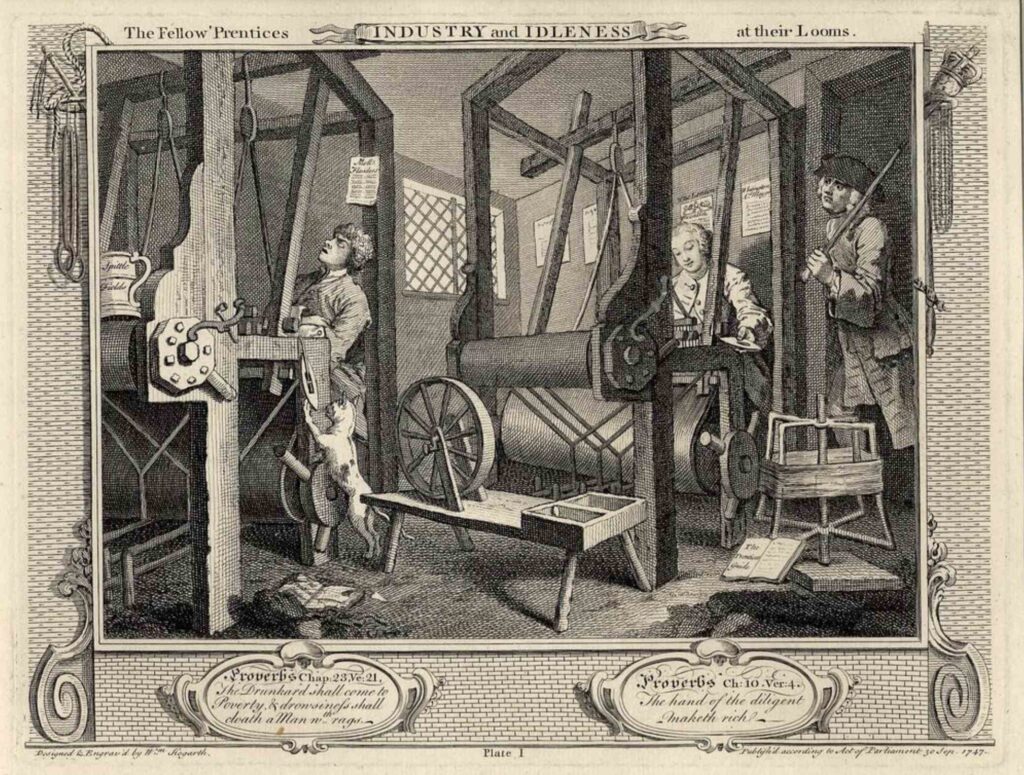
The fact that port cities figure in my book more conspicuously than inland centres has nothing to do with the distribution of putting-out networks. I know of only one very substantial monograph on putting-out—it is by a German scholar Rudolf Holbach7 Rudolf Holbach, Frühformen von Verlag und Großbetrieb in der gewerblichen Produktion (13.–16. Jahrhundert) (Stuttgart: Franz Steiner Verlag, 1994).. It is a massive book, running to some 500–600 pages, and it is extremely systematic: it covers practically every sector in which the putting-out system was used. It is a forbidding book because it is so large, but that is the only overall survey I am aware of. All the other literature on putting-out tends to be very fragmented. The distribution of putting-out networks would need to be investigated separately. For example, a large swathe of central Europe was dominated by a very substantial organisation of the putting-out system run by German capitalists. It is simply that port cities were where expatriate trading colonies were most extensively found and where the bulk of commercial capital was often concentrated — in other words, in the port cities.
Michael Miller’s book, Europe and the Maritime World, which I recommend—it is an excellent book—helps us to see how these different geographies (ports, hinterlands, etc.) were, or could be, integrated8 Michael B. Miller, Europe and the Maritime World: A Twentieth-Century History (Cambridge: Cambridge University Press, 2012).. He is not a Marxist, but it is a very valuable work. In other words, these were never stand-alone centres of capitalism or accumulation; they were always parts of wider networks organised either by trading companies or by the ports themselves, and so on.
My initial response to the first question is that we need to go back to some passages in Marx and Engels that directly discuss the putting-out system. And, indeed, surplus value is pumped out of domestic labour, and the fact that it is dispersed makes no difference to the capitalist nature of exploitation here. We can also draw a parallel between outwork in an industrial sense and the produce trades, which actually opens up the whole landscape of putting-out in a major way.
Evan Sedgwick-Jell: In relation to the first response and the issue of “hybrid subsumption”, something I very much liked in your book is the sense that you step back from the debate over whether something is formally subsumed or not. It becomes less a matter of introducing machines or even direct supervision of the work process; rather, power over networks and different modes of trading and shipping becomes a very central theme, and less about direct ownership of the means of production than about their mediation. That is something I found particularly strong in the book.
JB: Marxists should not be afraid of engaging with the literature on networks. In particular, even though it is not written by a Marxist, something like Miller’s book on three basic kinds of networks, and the way they are integrated with each other, offers a fruitful theme for Marxist ideas. I have even argued this with respect to—and this may sound like pure heterodoxy—Alfred D. Chandler Jr.’s The Visible Hand9 Alfred D. Chandler Jr., The Visible Hand: The Managerial Revolution in American Business (Cambridge, MA: Belknap Press, 1977)., which I think is the better of his two major works10 His other book, written in the 1980s, is Alfred D. Chandler Jr., Scale and Scope: The Dynamics of Industrial Capitalism (Cambridge, MA: Belknap Press, 1990)., and which one can read from a more strictly Marxist point of view. The whole argument about the emergence of large enterprises captures the real sense in which we have to understand the subordination of commercial to industrial capital. But we can come back to that later.
Mariana Bodnaruk: Here is the second question: Hugo Raine, in a piece for the Verso blog, makes the claim, from a Postonian perspective, that both you and Perry Anderson problematically conceive feudalism as a totality, or a unitary set of social relations11 Hugo Raine, “Marxism and the Middle Ages,” Verso Blog (October 30, 2018), https://www.versobooks.com/blogs/news/4105-marxism-and-the-middle-ages?srsltid=AfmBOoqmKkdQDQXmKYAdC8-sKhmsf3fBLbn0OsXfOvJVVLUSObbvMsjC.. Is this a valid critique? Do you see feudalism as having its own “laws of motion”, or is this feature unique to capitalism?
JB: Well, in the paper “Modes of Production,” I certainly seemed to think that we could not fully characterise a mode of production unless we had some sense or conception of its “laws of motion” (a term that Marx uses); that this was how Marx expected us to think about modes of production historically12 Jairus Banaji, “Modes of Production in a Materialist Conception of History,” Capital & Class 3(1) (1977): 1–44.. How else would we account for their decline? In other words, what kind of systematic or theoretical explanation could one have for the decline of any of these so-called modes of production unless one is thinking in terms of laws of motion? I am not sure what Raine means by feudalism being seen by Anderson and myself as a “totality”. Obviously, if one is looking at laws of motion, one tries to totalise them conceptually and not disregard any essential features.
Lorenzo Bondioli: The third question is as follows: In the book you mainly deploy the term “merchant capitalism” to describe the modus operandi of merchants. I have found this to be the occasion for some debate, since other Marxists would use “capitalism” as shorthand for the “capitalist mode of production”—that is, to describe a capitalist social totality, in which capitalist social relations prevail above all (and have, in particular, displaced “feudal” or “tributary” social relations). Do you think there is a difference between merchant capitalism as a mode of accumulation (your previous work speaks of “trajectories of accumulation”13 See Jairus Banaji, Theory as History: Essays on Modes of Production and Exploitation (Leiden: Brill, 2010), 333–348. ) and capitalism as a fully fledged capitalist mode of production? Where do you position yourself within the transition debate (on the passage from feudalism to capitalism) in this respect?
JB: This is a fairly long response, because it goes to the heart of the issue. I would like to make a general point here, which is that I get the feeling, in many of these debates and discussions, that there is a horror of what logicians call “fuzziness”. In the 1970s, I was reading extensively in a branch of logic called “many-valued logic”. The definitive text at the time was a phenomenal book, written for students of logic, by Nicholas Rescher14 Nicholas Rescher, Introduction to Logic (New York: St. Martin’s Press, 1964). . There is also a shorter book by Rescher, The Logic of Inconsistency, which deals with what are called “deviant logics”15 Nicholas Rescher, The Logic of Inconsistency: A Study in Non-Standard Possible-World Semantics and Ontology (Oxford: Blackwell, 1979)..
Much of this discussion of many-valued logics attempts to define, in a precise way, what “fuzziness” might mean. For example, if we make statements about the weather, no statement about the weather will be 100% correct. Many-valued logics involve three values: True (T), False (F), and Indeterminate (I). Whenever I read some of this material in the debates about transition, there is a tendency to confine the discussion to two truth values—T and F. If one is thinking in terms of I, or indeterminacy, it is as if one is transgressing something quite fundamental. So one way of giving a concrete sense to the dialectic—which is exactly how Marx constructed Capital, in terms of a dialectical evolution—is to think in terms of many-valued logics, and not to have a horror of fuzziness. We should not be afraid of the idea that we may end up with something fairly indeterminate. Let me illustrate this partly through my response to Lorenzo’s question.
When Marx used the expression “capitalist mode of production”, he meant industrial capitalism. The broad division within its history—the history of industrial capitalism—was thus between “manufacture” and “large-scale industry”. These are Marx’s terms. For Marx, large-scale industry begins in the later eighteenth century, and manufacture begins some time in the sixteenth century. He was therefore able to periodise everything from the sixteenth to the nineteenth century in terms of these two fundamental forms of industrial capitalism. He saw the former—manufacture—as historically coterminous with the centuries in which mercantilism was the dominant way of thinking about the economy, quintessentially the seventeenth century. In the passage in Grundrisse that I referred to in my first response, he speaks of manufacture “seizing hold” of rural secondary occupations16 Karl Marx, Grundrisse: Foundations of the Critique of Political Economy (London: Pelican Books, 1973), 510.. From Chapter 14 of Capital’s Volume 1, it is clear that Marx allowed for a form of manufacture based on specialised workers operating from home17 Karl Marx, Capital: A Critique of Political Economy, vol. I (London: Penguin, 1973), 462–463.; they did not have to be brought together in a workshop or factory. In other words, these workers did not have to be centralised in the workplace in order for manufacture to take place. Manufacture is compatible with dispersed, domestic-based production. So when he says that it “seizes hold” of rural secondary occupations—for example, textiles—this could (and probably does) simply mean that home workers are now subject to control by a capitalist. In other words, the idea of manufacture “seizing hold” of rural secondary occupations is tantamount to saying that all workers are now subject to domination, control, or exploitation by a capitalist, usually a merchant capitalist—that is, a merchant who would make sure that they produce “only for and through him”, as Marx puts it in Grundrisse18 Karl Marx, Grundrisse: Foundations of the Critique of Political Economy (London: Pelican Books, 1973), 510..
Now this is crucial, because if we see these early forms of manufacture as still bound up with the putting-out system, then one can argue that wherever they prevail, we are dealing with early forms of the capitalist mode of production—in the strict sense of the term—since manufacture is precisely seen by Marx as the first form of that mode of production. I hope the line of reasoning is clear here: Marx identifies the capitalist mode of production with industrial capitalism. He divides the history of industrial capitalism into manufacture and large-scale industry, and he allows manufacture to operate through the putting-out system. In other words, wherever putting-out exists on a substantial scale—where there is a widespread distribution of it—we are effectively dealing with an early form of the capitalist mode of production in the shape of manufacture.
But there is an ambiguity here—and this is my point about many-valued logic. If we use the term “capitalism” (which Marx almost never did) more loosely, then we can speak of a merchant capitalism that would, of course, include home-based forms of manufacture, but can and should also cover other forms of capitalist activity, such as international banking (for example, war finance) or the sort of large-scale commerce that was pursued by rival joint-stock companies. It involved sourcing products such as spices, textiles, and tea through supply chains organised internationally across vast distances.
So the upshot of this reply is simply that, if one wants to stick to a language centred on the capitalist mode of production, there is still a degree of flexibility, because, to the extent that manufacture in Marx’s sense was organised through the putting-out system, one can still speak, strictly, of the capitalist mode of production. But if one departs from that very rigorous or narrow view of capitalism as simply a mode of production, this allows for a looser sense of capitalism, in which one can include banking networks and large-scale commerce organised through supply chains established across international distances. Take, for example, the Dutch East India Company and the English East India Company. In the case of the Dutch, it was quite an intricate network, because they were extracting silver from Japan and exchanging it for goods in China, and so on. In other words, it was a multilateral trading system across various Asian markets.
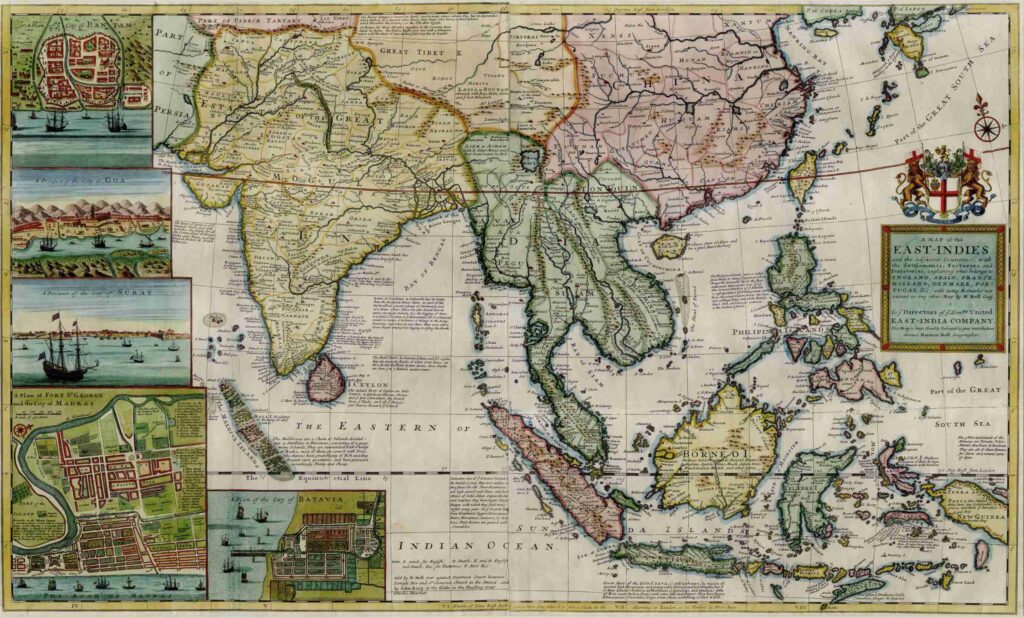
But essentially, as long as one can speak of supply chains in the strict sense, operating through these joint-stock companies—namely the Dutch and the English—then I do not see how we are not dealing with capitalism, which may be called merchant capitalism or commercial capitalism.
So the point about fuzziness comes in here. Do we make it a rule that we only speak in terms of the capitalist mode of production, or are we willing to allow for a looser definition of capitalism that subsumes these other forms? I think that we should go for the latter, even if the orthodoxy is inclined to say that capitalism is strictly a mode of production and that anything outside that conceptual boundary is somehow not worth discussing.
Juliana Gleeson: This is a historiographical response to the second and third questions. Something which interests me a lot in historiography is that, at this point, we have overcome many of the conditions that were shrouding scholarship from the late 1980s through the 1990s. In much of the medieval work, especially by the time of John Haldon’s book on the tributary mode19 John Haldon, The State and the Tributary Mode of Production (London: Verso, 1993)., there is a sense of trying to prevent a rout—a rearguard quality to much of the Marxism that appeared in the early 1990s: Marxists responding to the post-structuralist menace, or whatever else; a sense of Marxism having to be protected and preserved. Today, after 2008 and the financial crisis, that defensive quality seems to be diminishing. So I am very interested to hear how those overarching conditions have shaped your thinking in this book, or whether they have at all. It feels as though there is no longer a need for Marxist apologetics, and that we can develop the best available systems. I am also interested in the notion of fuzzy logic as a way of working out what the best approach might be—do we still need to rely on appeals to the systemic, at least to the extent that we have?
JB: Yes, to some degree I was influenced by the fact that, if you look at the whole of the last quarter of the twentieth century, something quite profound has happened to the structure of capitalism worldwide, which is that manufacture loses its dominance. It partly loses its dominance because it is deconcentrated; and it is deconcentrated because it begins to organise supply chains in the Far East, which is how you get this huge surge of industrial capital. Japan was already advanced as an industrial capitalist economy, but you have a surge of industrial capital in the last 25 to 30 years of the twentieth century, as discussed by scholars. It is producer-driven; it is manufacturers in the West who find it cheaper to outsource or subcontract, and no longer to produce within their domestic economies.
Simultaneously with that, from the early 1980s, you get an explosion of financial markets, something which begins in the US. It starts with bonds, with the bond market, which just goes through the roof at that stage, and, of course, you have derivatives trading taking over by the mid-to-late 1980s, culminating in the crash in 2007. So, a great deal of capitalism is being driven by the financial markets, by the energies being built up and released there, and that is the context in which you have this entirely new language developing—and language is important to the kind of capitalism we are talking about—of shareholder value, corporate governance, and so on. In other words, it is as if a new constituency muscles its way into the conduct and management of capitalism, which is basically financial investors and shareholders, who have nothing to do with the management of these enterprises but have a huge stake in the way they are run. So there is this rift between powerful, autonomous managers, especially in the US, on the one side, and the people who supply this equity, namely the financial investors, on the other—and it is against that background that you see the whole debate around shareholder value and corporate governance emerging. That too was specific, or peculiar, to the 1980s and 1990s, and can be said to have been formulated around 1990–1992.
On the one hand, you have manufacturing being shifted, in a major way, out of the Western economies; and on the other hand, you have the explosion of finance capital of a new kind—Wall Street–based finance capital. Then, of course, you have the growth of retailers, the mass retailers, like Walmart and so on, who, because there is intense competition among manufacturers for shelf space, are able to charge for having products displayed in large department stores or chains—for example, Sainsbury’s in the UK. I am sure you have similar kinds of large retailers in the US who charge for displaying products on the shelf.

If one looks at these three processes in relation to each other — the deconcentration of manufacturing and its relocation to other parts of the world; the explosion of finance capital in a strictly Wall Street sense, the investment banking industry from the 1980s onwards, culminating in the crash of 2007 (which does not mean that derivatives trading has disappeared—on the contrary, it is alive and well); and finally, the change in the balance of power between manufacturers and retailers, especially the large retailers—one begins to see a broader transformation.
Walmart, in particular, begins to shut down many of its supply sources in the US, creating huge job losses—millions and millions of jobs have been lost—fuelling, of course, the later rise of Trump. At the same time, there is a shift of production to China, so that China becomes the single-source supplier for many Walmart products. Meanwhile, there is mounting unemployment, not just because of Walmart and similar firms, but also because, across a range of basic sectors, there is a loss of competitiveness. The US tyre industry, for example, was taken over wholesale by foreign companies—Bridgestone, a Japanese firm, took over Firestone in 1988. You have Pittsburgh steel in total crisis; in a sense, it is the Japanese who crush American steel, and so on. One can trace the decline of American manufacturing capital across three decades of the twentieth century, and all of these economic processes weigh on the kind of politics we see in the twenty-first century. Trump is essentially exploiting the grievances that have built up as a result of the loss of American manufacturing primacy. No administration in the future is likely to avoid the question of whether, politically, it has a stake in recovering manufacturing dominance; every administration will have a stake in restoring American manufacturing strength.
That is essentially what happens: capital is reconfigured in a very dramatic way at the end of the twentieth century, and those changes are obvious. They dislocate the comfortable feeling that we have an orthodoxy about industrial capitalism, because in so many ways the hegemony, the centrality of industrial capital is being called into question by precisely these sorts of changes—whether vis-à-vis the financial markets or vis-à-vis large retailers like Walmart. I hope that at least partly addresses the question. One cannot help but be influenced by the kinds of reconfigurations that were taking place at that time.
Jordy Cummings: This is a two-part comment. First, I really appreciated the introduction of the theme of fuzzy logic. I am curious about the account you offered of the extraction of surplus labour from direct producers. I am interested in the shifting modalities of surplus extraction, whether it is surplus value or not, and in the interaction between that and the shifts in commerce. Second, I appreciate the idea of the “fuzzy”, but is there an example—a counter-example—of non-capitalist large-scale commerce where one could explicitly say: this is non-capitalist commerce? That is, there is large-scale commerce organised across a vast geospatial terrain, but it is not capitalist. Or are there germs of capitalism in all large-scale commerce?
JB: To start with Jordy’s second point, again there is an ambiguity in the term “large-scale”, because China had vibrant markets for centuries, and Roy Bin Wong argues in his book that this was the Smithian scenario of market expansion encouraging a division of labour, specialisation, and so on, without this particular economic regime ever graduating into full-blown capitalism because of the power of the Chinese state20 Roy Bin Wong, China Transformed: Historical Change and the Limits of European Experience (Ithaca: Cornell University Press, 1997).. The Chinese state, unlike the states in the West, namely the Italian mercantile states, had no particular interest in encouraging commercial capitalism. In fact, when China did begin to expand internationally and organise these huge trading missions to the West, there was a sudden pullback and they just abandoned that whole exercise in mid-air, so to speak. I think Wong has constructed a very powerful argument for two apparently contradictory things. On the one hand, vibrant market expansion through much of Chinese history, certainly all the way down to the nineteenth century, where scale refers not so much to individual units of capital, but to the aggregate, the way the peasant economy worked in aggregate, so to speak. Many small-scale producers were producing a range of commodities for market and for a variety of reasons, whether for tax or whatever. So in the aggregate there was a substantial scale of market activity and expansion, but this never passed over into capitalism in the sense we discuss it in the Western context. This is a Chinese exceptionalism argument, but when I read Wong’s book I was convinced by it, he argued it very well.
That does not mean that we cannot have books like Chinese Capitalism21 Of the three-volume history of Chinese capitalism, originally published in China in the mid-1980s, the first volume was abridged and translated into English: Dixin Xu and Wu Chengming, eds., Chinese Capitalism, 1522–1840 (New York: St. Martin’s Press, 2000).. In fact, there are three volumes that, chapter by chapter, discuss capitalist activity, accumulation, and organisation in the Chinese economy. It just means that the economy as a whole was not driven by this particular class of commercial capitalists. They never achieved power, they never dominated the economy as a whole, and never restructured it. That was a state of affairs that survived all the way into the twentieth century. Of course, in the Comintern there were debates about the nature of the Chinese economy. People like Karl Radek argued that, basically, the only form of capital that mattered in China was commercial capital: there was no significant industrial capital in China. That was Radek’s position, which I think was right. That is the point about whether you can have a non-capitalist, but nonetheless commercial economy: I think that is precisely what China was.

Nicholas Matheou: What I wanted to bring in is a question of specificity and naturalisation, and how specificity has been understood, particularly in the Political Marxist tradition, and how it should be repositioned. Some might say your model might lead to a naturalisation of capitalism, given your opposition to Maurice Dobb, Robert Brenner, and others, who have insisted on the specificity of capitalism as compared to the modes that preceded it. Is it possible to denaturalise capitalism ideologically if we do not acknowledge capitalism’s specificity? Do you consider the denaturalisation of capitalism necessary to the socialist project as a whole?
JB: The response to that is yes, absolutely. The essence of ideology is that social relations of different kinds are naturalised. The obvious examples are family, marriage, patriarchy—all of which have been deeply naturalised through much of history. I do not think that an attempt to rethink the history of capitalism in a more up-to-date and materialist way incurs any such risk, as long as we are aware of what we are doing, right? I do not think any appearances to the contrary. For example, in work that I have done on late Roman history, I have been able to show there was massive monetary expansion from the fourth century to the seventh century. This was based on a high-value gold coinage called the solidus. The whole book, Agrarian Change in Late Antiquity, is an attempt to show what this would have meant in terms of the Roman economy more widely, and in terms of class relations22 Jairus Banaji, Agrarian Change in Late Antiquity: Gold, Labour, and Aristocratic Dominance (Oxford: Oxford University Press, 2001)..
Alice Nilsson: My question is related. How would these Roman economy sectors, which you mentioned, run along capitalist lines if that would depend on the dispossession of a swathe of people in order to have a labour force for this production? Brenner, Ellen Meiksins Wood, and others point out that markets and flourishing commercial cities were able to function fine without being antagonistic to the feudal mode of production. For me, it seems absurd to claim that something can be run along capitalist lines without saying it is situated within a capitalist mode of production and qualifying this—meaning a labour force that depends on doing this labour in order to attain its means of reproduction.
JB: I do not characterise the Roman economy in this period as capitalist, contrary to what one reviewer repeatedly claimed—namely Tom Brass23 Tom Brass, “Do All (Capitalist) Modes Lead to Rome?,” Critical Sociology 47(3) (2021): 515–522.. There is, however, a whole tradition of Roman historiography, known in the field as “modernist”, which in some ways goes back to Theodor Mommsen. This tradition has never had problems talking about capitalists in the Greek and Roman world, since it is obvious that numerous activities were profit-driven—in other words, they were undertaken and organised in order to generate profit. However, as far as I know, none of the modernists—including the rare Marxists among them, and Arthur Rosenberg was one of those rare Marxists who called himself a modernist—ever believed we could extrapolate from this to a capitalist mode of production. It was obvious to Rosenberg that there were powerful capitalists in the Roman Republic and early Roman Empire, and so on, but he never thought of saying that therefore Rome had a capitalist mode of production. Again, it is one of those cases where we need to retain a sense of laws of motion. None of them believed that we could extrapolate from this to a capitalist mode of production, even when there were whole industrial sectors—such as the Roman fine ware industry—that were clearly organised on what could be described as capitalist lines. This refers to the kind of work that the French/Italian archaeologist Jean-Paul Morel has done on ceramics. Morel, in particular, in those massive volumes edited by the Marxist historian Andrea Giardina and published by the Institute Gramsci in Turin, has an excellent paper on the organisation of the fine ware industry which shows the particular respect in which we can actually talk of a capitalist industryJean-Paul Morel, “La produzione della ceramica campana: Aspetti economici e sociali,” in Merci, mercatie scambi nel Mediterraneo (Società romana e produzione schiavistica, vol. II), edited by Andrea Giardina and Aldo Schiavone (Bari: Laterza, 1981), 81–97..
So there is a problem here for historical materialists to take up—a problem of theory. Paolo Tedesco and I defined this in a paper we published in the Journal of European Economic History in 201724 Jairus Banaji and Paolo Tedesco, “Giuseppe Salvioli’s Capitalism in the Ancient World,” Journal of European Economic History 46(3) (2017): 145–156., where this problem was laid out in a discussion of Giuseppe Salvioli’s anti-modernist book Capitalism in the Ancient World25 Giuseppe Salvioli, Le capitalisme dans le monde antique: études sur l’histoire de l’économie romaine (Paris: V. Giard & E. Brière, 1906).. The point being made is that you can talk about capitalists, and you can even talk about capitalist sectors of production—such as the wine industry, the olive oil industry, ceramics, and so on—without necessarily committing yourself to the position that we are dealing with a capitalist mode of production. There is a distinction there that I think is quite tenable. In relation to the questions raised by both Nik and Alice, it may be worth noting that I have now restated my views on the Roman economy and on Roman conceptions of capital in an essay called “Rostovtzeff’s Shadow”, which Studi Storici will publish later this year.
Neil Braganza: That brings us to the next question. A key moment in the history that you cover is when the “competition between commercial capitals drew the state into its dynamic”, as you put it on the Legal Form blog26 Jairus Banaji, “Capital Before Large-Scale Industry,” Legal Form: A Forum for Marxist Analysis and Critique (November 18, 2020), https://legalform.blog/2020/11/18/capital-before-large-scale-industry-jairus-banaji/.. You argue that this interdependence of merchants and states begins with Venice in the twelfth century. Furthermore, in the Appendix to your book, “Islam and Capitalism,” you mention that “the non-development of capitalism [in the Islamic world] was less about a failure to emerge than about the failure to acquire a more collective, corporate form that could express and contribute to the solidarity of a class (…) Venice and Genoa (…) ‘subordinated the state more securely to themselves’ (…) [and] this failed to happen anywhere in the Islamic world”27 Jairus Banaji, A Brief History of Commercial Capitalism (Chicago: Haymarket Books, 2020), 132.. It seems, then, that your account of the connection between the economic and the political—between merchants and the state—which is so key to how capitalism develops into its later forms, rests on a view of the distinctiveness of Roman legal-political ideas, and of how these ideas facilitated the formation of the capitalist class. Can you say a bit more about the kind of legal-political theory that made European rulers uniquely receptive to linking state power to the expansion of commercial activity?
JB: This is a fascinating question, and it basically invites a whole scientific research programme in the sense of organising forms of collective and sustained research. Let me make a distinction here between, on the one hand, the Italian states that bolstered the drive into the Byzantine and Islamic markets from, let us say, the early ninth century—variously described as city-states, merchant republics, and so on—and, on the other hand, the large absolutisms that emerged by the fifteenth century and became natural allies of powerful groups of merchants.
Of the former, Marx says in Capital, Volume III, that the merchants in Venice and Genoa subordinated the state more securely to themselves, and this is already posited in the question itself. Some would argue that something similar happened with the major absolutisms. We are not talking about the subordination of the state to merchant capital when we refer to these large medieval, late medieval, and early modern absolutisms. Here, the more appropriate image would be the one used by the French historian Georges Lefebvre in the first transition debate between Paul Sweezy and Dobb, namely his suggestion that it was the collusion between the state and commercial capital that drove the expansion of capitalism28 Georges Lefebvre, “Some Observations,” in The Transition from Feudalism to Capitalism, edited by Paul Sweezy et al. (London: Verso, 1976), 122–127.. If you are looking for a kind of motor that drives capitalism from, say, the sixteenth century onwards, it is this. There are any number of terms one can use—“collusion” was his word; one can also talk about “partnership”, “alliance”, and so on. I think “partnership” is what Brenner uses. This is more than a nuance; it marks the difference between the North Italian merchant republics on the one hand and the large territorial monarchies on the other. It describes two very different sets of relationships between capital and the state, even if the consequences were broadly similar. Brenner himself cannot disagree, since he repeatedly underscores the partnership between the more powerful London merchants and the English monarchy going back to Queen Elizabeth and the mid-sixteenth century from the 1550s onwards. He does not only use the word “partnership”; he describes the relationship in a number of different ways.
Having drawn attention to this basic distinction—namely, that on the one hand we have the North Italian merchant republics, which do manage, because of issues of scale, to subordinate the state to their own economic interests—the situation is very different with the early modern monarchies that emerged later. One cannot expect capital to establish immediate domination or control over these states. The more accurate description is that there is a kind of partnership between them.
As for political theory, the inheritance of Roman private law was obviously crucial to the mercantile states of northern Italy. But since large parts of the Italian peninsula were still under various forms of Byzantine rule, particularly in the south, and Venice itself was under a form of Byzantine sovereignty, there was also relatively easy access to eastern markets. This is a point stressed by the Byzantinist Angeliki Laiou, namely that Byzantium, unlike both the Catholic West and the Islamic world, had no sanctions against usury29 Angeliki Laiou, “Nummus parit nummos: L’usurier, le juriste et le philosophe à Byzance,” in Angeliki Laiou, Economic Thought and Economic Life in Byzantium, edited by Cécile Morrisson and Rowan Dorin (Aldershot: Ashgate, 2013), 583–604. . This particular cultural and legal constraint was, uniquely, completely absent there. Laiou’s argument is an interesting one, namely that what was peculiar to the medieval East Roman Empire was that it never had any restrictions on the extraction of interest through loans30 See Jairus Banaji, Exploring the Economy of Late Antiquity: Selective Essays (Cambridge: Cambridge University Press, 2016), 1–34..
When it comes to the early modern autocracies, it is the convergence between state interests and the interests of commercial capital that becomes important. Here we need to sort out the whole issue of mercantilism—or, better still, mercantilisms in the plural. On this, see also the latter part of my paper, “State and Capitalism in the Era of Primitive Accumulation”31 Jairus Banaji, “State and Capital in the Era of Primitive Accumulation,” in Jairus Banaji, A Marxist Mosaic (Leiden: Brill, 2023), 454–471., as well as John Brewer’s seminal book The Sinews of Power, which is entirely about how Britain became such a powerful state in the course of the seventeenth century32 John Brewer, The Sinews of Power War, Money and the English State 1688–1783 (London: Unwin Hyman, 1989).. We do not yet have definitive answers, but there are some pointers in the direction of the survival of Roman private law—including commercial law—which is important, as well as access to markets such as the huge Constantinople markets, and so on. That would be the response. But this is an interesting question that implies a whole scientific research programme in Paul Feyerabend’s sense.
Neil Braganza: Thank you very much, Jairus, for your replies. On the idea of a broader research programme: what I really like about our reading group and this community online that we have is just how interdisciplinary it is, and the work by people like Juliana in fostering that kind of interaction across such a wide range of inquiry. Knowing that this is the basis of solidarity, and of deep thinking and struggle together, I think that is one way in which I am appreciating your rejection of “two-valued” logic in favour of inquiry and the “indeterminacy” and openness of inquiry that builds, expands, and integrates things. On that note, we know that with Marxist historiography there can sometimes be a kind of closure, an emphasis on definitions as prior to history, rather than history prior to definitions. Finally, what motivated my question about political theory or legal theory—about what underlies this collusion or partnership between merchant activity and state power—is, in part, my hypothesis in response to my own question, pending this broader solidarity of research: namely, to think about how Roman law, and certain kinds of legal thinking more generally, might favour “two-valued” thinking, and how that in turn can serve as a basis for ideology and coordination in the form of abstract, contract-based imposition of constraints on people’s lives, all of which is bound up with relations of exploitation and alienation. That is just a general comment on your reply and our conversation. Thank you.