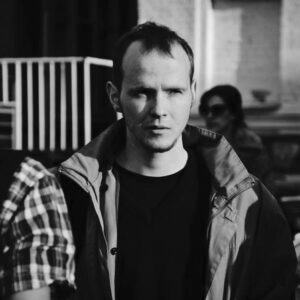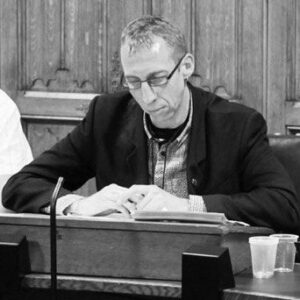
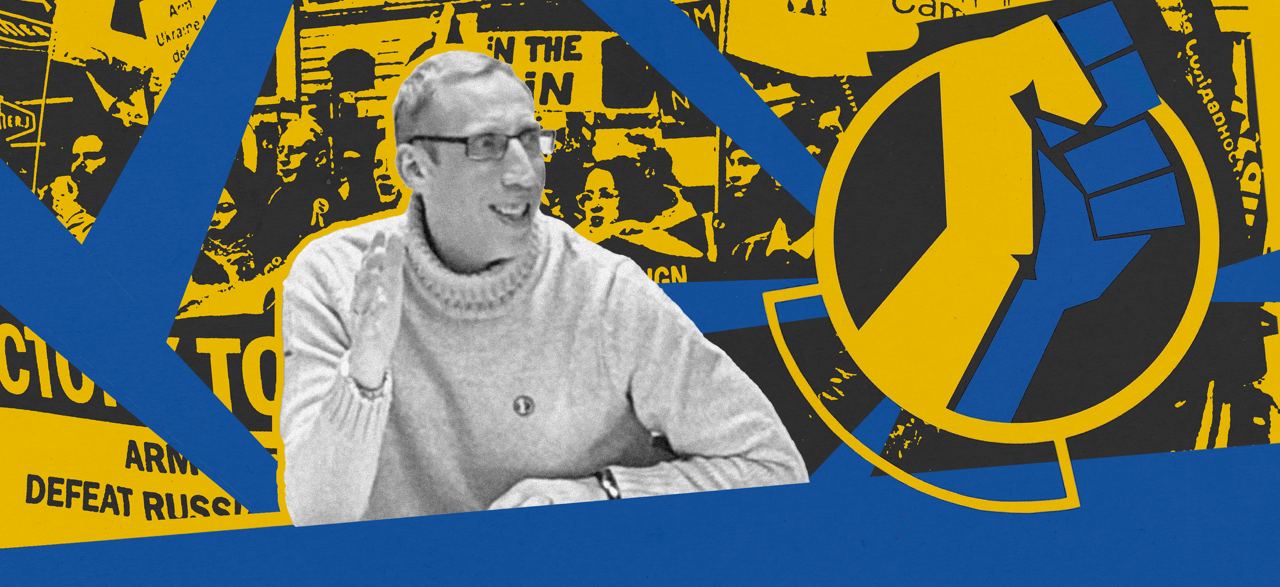
Chris Ford is a British historian originally from Scotland, as well as a leftist and trade unionist. He is one of the founders of the Ukraine Solidarity Campaign (USC), which for the past 11 years has been successfully working to mobilize left-wing and trade union movements in the UK in support of Ukraine. His research focuses on the study of anti-Stalinist workers’ opposition, cooperation, and the historical role of progressive, anti-colonial movements in the struggle for national self-determination. Chris smuggled diaspora publications into Soviet Ukraine and has supported independent trade unions in Ukraine since their establishment.
Artem Tidva from the Ukrainian NGO Social Movement sat down with Chris Ford to talk about his militancy, the Ukrainian Solidarity Campaign and the reasons they support Ukrainian resistance.
Artem Tidva: Could you tell us about your educational background, and how you first became acquainted with Ukraine?
Chris Ford: I did my first undergraduate in Ukrainian history, and then I pursued postgraduate studies in Ukrainian history at the School of Slavonic & East European Studies at University College London. My dissertation focused on the Ukrainian Social Democratic Workers Party, the Nezalezhnyky.
My interest in Ukraine began in a practical way through the Polish Solidność movement while I was living in Scotland. During the 1984 Great Miners’ Strike, Jaruzelski’s Soviet-backed regime in Poland sent coal to help Margaret Thatcher’s government break the strike. At that time, I started writing and campaigning in support of Solidność. Through this work, I met progressive members of the Ukrainian diaspora, which sparked my deeper interest in Ukraine.
One of the first progressive Ukrainians I met were Bohdan Krawchenko and Marko Bojcun. Overall after the Second World War many representatives of the independent Ukrainian left fled from the USSR and settled in the UK. Krawchenko and his comrades published the Ukrainian diaspora magazine Dialogand smuggled it into Ukraine during the Soviet era. In English, he published the META magazine together with Mick Antoniw, a future Welsh MP of Ukrainian descent. Krawchenko lived in Canada, where he later headed the Canadian Institute of Ukrainian Studies. Through Taras Kuzio and the publishers of the magazine Suchasnist I had the privilege to meet dissidents and Gulag survivors Leonid Plyushchand Levko Lukianenko, whom I accompanied to meetings with the Socialist International. The Dialog collective originally had ties with the anti-Stalinists Trotskyist Fourth International, but had moved in a more independent direction. Krawchenko was one of the founders of the highly respected journal Krytyka edited by the South-African Marxist theorist Hillel Tiktin.
Furthermore, the Dialog had close links with the Ukrainian Revolutionary Democratic Party (URDP) which published the journal Vpered. The survivors of the Ukrainian radical left founded URDP in 1947, spearheaded by figures such as Ivan Maistrenko, Hryhory Kostiuk, Borys Levytskyi.
I had the privilege to become personal friends with Levko Maistrenko — the son of the famous Ukrainian revolutionary Ivan Maistrenko. Levko was a member of Ukrainian Revolutionary Democratic Party known from 1990 as the Ukrainian Democratic Republican Party. He was the one who helped me publish a new edition of the Maistrenko family history.
In the 1980s, I met Marko Bojcun, and we later collaborated on publishing the Ukraine Today journal during the Rukh period. Marko and I shared common views on the national question and progressive left politics. He had already completed his dissertation by that time, and in 2017 his book The Workers’ Movement and the National Question in Ukraine was published.
History for me was always very important, and as a historian, I tried to highlight the truth of people that differed from the official line of the Stalinist and traditional left propaganda. The Kremlin tried to portray all anti-Stalinist shades of resistance — especially on the left — as traitorous, and everything Ukrainian as far-right, ultra-conservative, or fascist. Yet there was all this history that was very progressive, which I believe was really important that we try to bring out in order to trace the roots of our own movement. It was the progressive forces — the social democrats and socialists — who pioneered the rebirth of Ukraine, not the conservatives.
In the 1980s, we organized support for Ukrainian self-determination and dissidents in Soviet Ukraine through the Polish underground. I smuggled aid to the Polish underground and, via Poland, to dissidents in Ukraine. I introduced dissidents from Lviv to comrades from the reformed Polish Socialist Party (PSP). Together with the PSP, young Ukrainian leftists, and Latvian Social Democrats, we organized an illegal demonstration in Warsaw in August 1989 to mark the anniversary of the Hitler-Stalin Pact. Marko and others had already established contacts with the People’s Movement of Ukraine (Rukh), and we republished their founding declaration in Ukraine Today, along with that of the new Lviv Social Democrat organization.
Being of Irish heritage and from Scotland, I was naturally interested in issues related to the national question. Recognizing parallels with Polish history, I began studying the history of the Ukrainian left. Moreover, at that time, pioneering works were appearing, such as James Mace’s book on national communism.
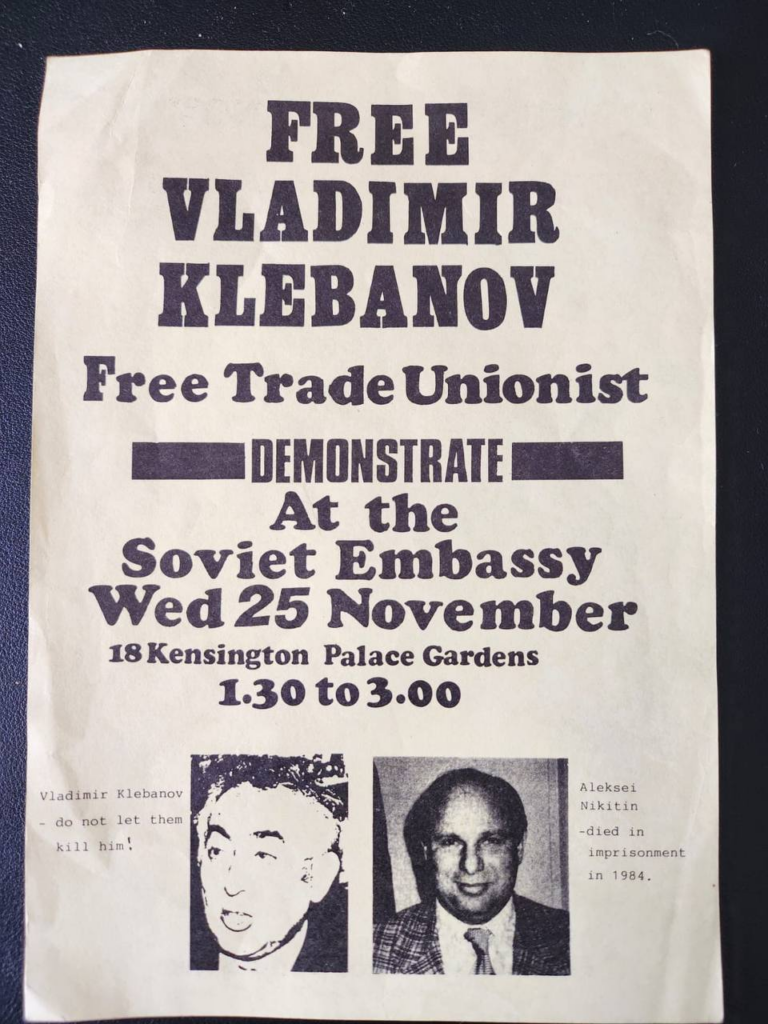
I combined my interest in history with activism. When I first visited Ukraine in 1985, I brought samizdat leaflets from dissident comrades supporting independent trade unions: “For Ukraine’s Freedom” and “Against the War in Afghanistan.” I left them in phone booths in Kyiv and Donetsk, where distributing such material was strictly forbidden. Later, I campaigned for the dissident miner Vladimir Klebanov, who organized a free trade union in the Donbas.
I was eager to meet the new Ukrainian left. I believe the first Ukrainian leftist I met was Zakhar Popovych, around 1999, in the Netherlands, where an international conference was held that was open to representatives of the new left. As I was a supporter of humanist Marxist movements, I was also invited.
How long has the Ukraine Solidarity Campaign existed, and how was it formed?
When Euromaidan began, Marko and I gathered an initiative group to discuss two things: understanding what was really happening in Ukraine and providing practical support to progressive Ukrainian leftists. In the UK Parliament, we organized hearings on current events in Ukraine and appropriate responses, inviting speakers from Ukraine — Zakhar Popovych and Volodymyr Ishchenko — who represented different perspectives. On the British side, Jeremy Corbyn and John McDonnell also spoke.
There was intense debate in British society about both the reactionary side of the Ukrainian protest and the progressive aspects of the Revolution of Dignity. Zakhar spoke about the independent trade unions in Kryvyi Rih and the involvement of the workers’ movement in the Euromaidan protests. This grassroots support was often overlooked by the media, even though it was an important part of these political and historical developments. This caused a major split in the British left: Stalinist and conservative groups supported the Communist Party of Ukraine’s “anti-Maidan” stance alongside Yanukovych and Berkut, while progressive leftists sided with the protests against police brutality and the killings.
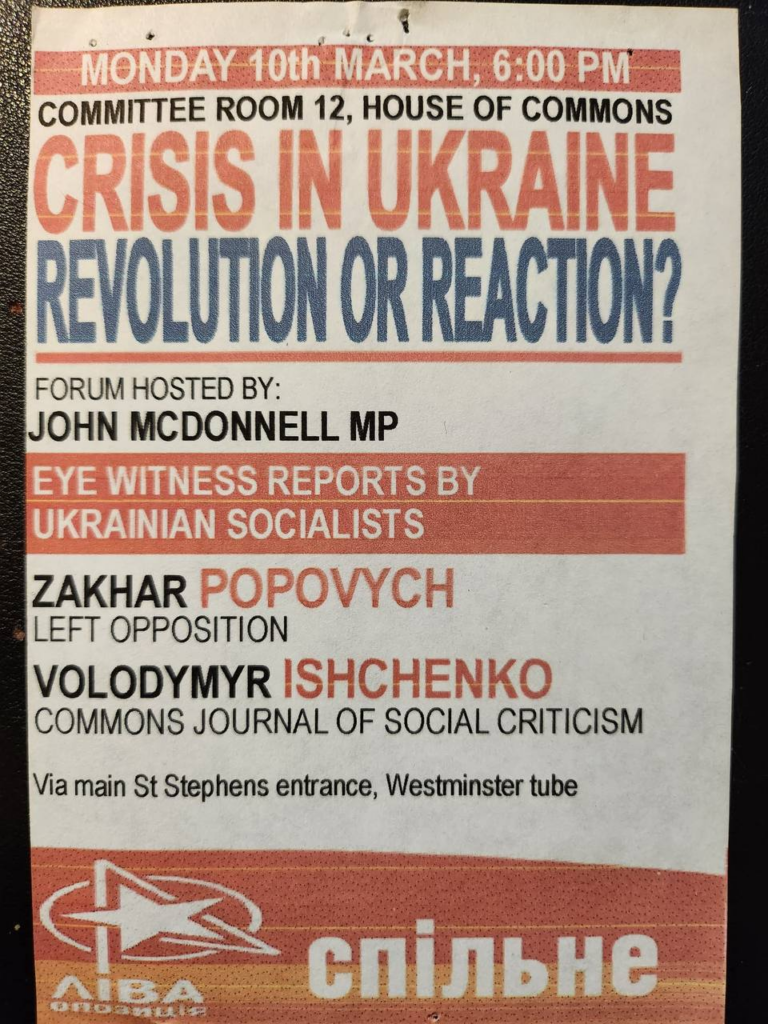
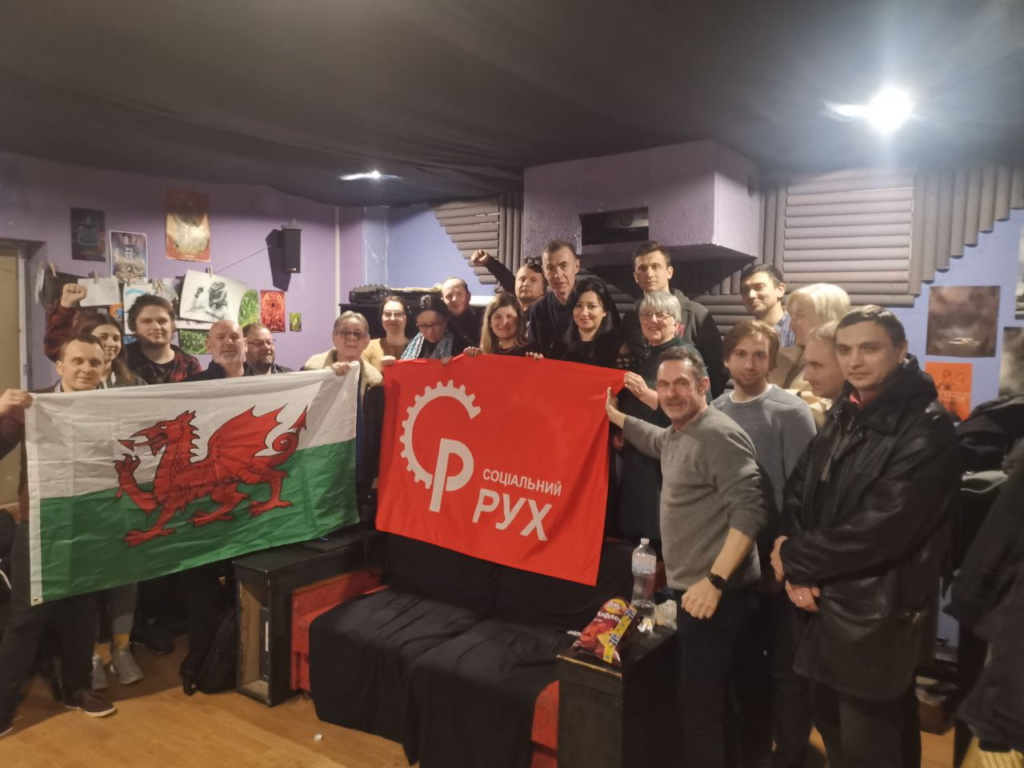
I brought together British anti-Stalinist leftists who supported Euromaidan and had generations of experience resisting the Stalinist regime: Marko Bojcun, Halyna Kovalska, and Mick Antoniw. We wanted to strengthen progressive Ukrainian leftists in their struggle against Russian imperialism. That’s how we founded the Ukraine Solidarity Campaign (USC).
USC’s first campaign after 2014 came when, amid the devaluation of the hryvnia, miners organized by the Independent Trade Union of Miners of Ukraine (NPGU) at several mining enterprises demanded wage increases in this highly profitable iron ore export sector. We staged a major demonstration before a Chelsea football match — the club was owned by one of the oligarchs (Roman Abramovich [ed.]), who also owned several mining companies in Kryvyi Rih.
Together with British MP John McDonnell, we organized a conference of the new left and democratic trade unions in the House of Commons and invited Ukrainian speaker Nina Potarska from the socialist and feminist movement in Ukraine.
At this we had a lot of problems because another campaign was active in the UK, called Solidarity with Antifascist Resistance in Ukraine, which was clearly pro-Russian. One large British railway workers’ union, the RMT, supported them, and they had a number of leftist groups, including the Communist Party, as well as a number of Russian chauvinists, with their groups bigger than ours.
Some of them tried to get inside our conference, and they caused a huge amount of conflict and disruption. They were also there with a lot of Russian chauvinists, wrapped in their Tsarist St. George ribbons, led by the now leader of the RMT union, Eddie Dempsey. The atmosphere was very toxic. They tried to intimidate us and silence us, but they failed. It was a very different atmosphere in the UK from now, because Russia, those days, was operating with lots of hybrid warfare, lots of disinformation, poisoning the minds of people a lot, and some people were very happy to be poisoned. There was no shortage of Potemkin village idiots.
It was very difficult, but we got the support of two trade unions — the National Union of Mine Workers (NUM) and the train drivers’ union, ASLEF. This was in 2014–2015. Mick Antoniw helped to set up contacts between the UK’s NUM and Ukrainian miners from Pavlograd, Donbas, and then with Ukrainian railway workers. We already had contact at this time with the NPGU, and we held a marvellous event in Parliament with Yuriy Samoilov speaking from Kryvyi Rih. I remember a number of young Ukrainians attended this event and also helped translate. From this, we began to gain some respect among the new Ukrainians who came after Euromaidan.
Over a period of time, we carried out some very successful solidarity actions with workers in Ukraine. We knew rail workers in Kyiv, met many times with miners, and ran several campaigns. We also held numerous briefings in Parliament, which we continued to do. Later, others came to Britain who helped a great deal, such as Yulia Yurchenko. All our groundwork and activity put us in a very good position when the full-scale invasion began, enabling us to build solidarity.
How has USC’s mission changed over the years?
The original mission was to organize solidarity and provide information in support of the Ukrainian labor movement for working-class democratic rights, against imperialist intervention and chauvinism; to coordinate socialist and labor movement organizations; to build direct links with independent socialists in Ukraine and the trade unions; and to support the Ukrainian people in determining their own future, free from Russian and Western imperialism. The original stated goal has not really changed.
And when the full-scale invasion began, the circumstances became a little more favorable to us than to those who supported Russia. Pro-Russian forces were not as explicit and aggressive as they had been after Euromaidan. Within the labor movement, it became more sympathetic: we were able to mobilize more people than during Euromaidan, and the amount of support and interest for Ukraine was much greater than it had ever been. It is worth noting that just after Euromaidan there was a lot of interest in Ukrainian topics, but there was also simultaneously significant opposition: lots of misleading material was published, many lies circulated, and “experts” often knew very little. Whereas this time, after the full-scale invasion, I think there was widespread genuine support. In the trade unions, whenever we went to a democratic conference to decide on support for Ukraine, the overwhelming majority of workers would vote in favor. The pro-Russian position never won the democratic vote; instead, they adopted bureaucratic tactics to block us. Also, I think our coordination and links with the trade unions in Ukraine became closer, obviously because of the aid work that we had organized.
Our campaigns were also more organized and formal than before. During Euromaidan and afterwards, Marko Bojcun, some others, and I wanted to take a stronger position to support Ukraine militarily against Russian aggression, but it was uncomfortable for some people. There had also been disorientation among the new left after Euromaidan in opposing the anti-Maidan forces or in clearly supporting Ukrainian defence. Some people took a more neutral approach and didn’t really want to be explicit in supporting Ukraine’s military resistance against Russia and their occupation of Donetsk and Luhansk.
I have to say that it was also a big mistake for all of us in the global leftist movement, but I think this time, with the full-scale invasion, we were able to take a stronger, more robust position against Russian imperialism and in support of the national liberation struggle. This evolution of thinking on the left here seems very positive to me. I also think that is important for a critical understanding of global processes, because we face a different context of growing fascism and authoritarianism today, and we need to understand the importance of military resistance in this context.
For us, as the USC, the situation now is different from that of Euromaidan — we have been able to evolve in a stronger way. At that time, we had two British trade unions participating in the USC, and now we have six. The majority of them have no doubt about providing donations to support soldiers in Ukraine. Other trade unions are still uncomfortable with that and want to focus more on humanitarian issues. So that is still a debate we are having: the UK has fought many reactionary wars, and therefore, it seems like a real leap. However, it is an adjustment that needs to be made for a change of consciousness, to begin to understand the need to support military resistance.
Before the Second World War, many people were very reluctant to support a war because of the terrible experience of the First World War. But the struggle against fascism was necessary. Today, we face a similar problem: we need people to re-orientate. We have sought to highlight the very clear link between the Putin regime, the war on Ukraine, and the far-right globally. In the UK, the far right is clearly pro-Russian or pro-Putin; they oppose aid to Ukraine, attack Ukrainian refugee rights, and, where they have power, have removed Ukrainian flags from local government buildings.
Who is your target audience in the UK?
As I said earlier, from the beginning, the USC had very loyal support from two trade unions. The National Union of Mineworkers has many historical links to Ukraine, including some MPs close to them who had been to Donbas. The drivers’ union, ASLEF, has supported the campaign as well. Some of their members even visited Kyiv a few days before the 2022 invasion, making it to the office of the Sotsialnyi Rukh (Social Movement NGO). Their delegation showed our support. It was important to us that the USC stood with the Ukrainian people. With the support of these two big trade unions, we won important policies and played a big part.
The GMB union, which is affiliated with the USC, has maintained a very strong position in support of Ukraine and against Russian imperialism. Together with them and the other two unions, we coordinated efforts regarding Labor Party policy; we were quite instrumental in formulating the motion that was presented. The Trade Union Congress (TUC) — the equivalent of the FPU or KVPU in Ukraine — played an even more important role. We mounted a major campaign with our allies and these trade unions, and they submitted a joint policy to the TUC. That was important because, before the full-scale invasion, the TUC didn’t have a strong policy on Ukraine. That was a significant step.
The TUC leader, Paul Nowak, who is of Polish heritage, also shifted his position to a very pro-Ukrainian one. Moreover, he visited Ukraine to meet with the trade unions himself. This year, he spoke at our meeting, marking the first time he has ever officially supported our campaigns. That was a big achievement: the conferences of the two main bodies have now adopted pro-Ukraine positions.
Our USC trade union officer, Sacha Ismail, has done incredible work organizing networks of supporters within certain trade unions and assisting our allies in others, such as UNISON and Unite. We campaigned within UNISON — the largest union in Britain — and won their support as they joined the campaign. We also worked with the University and College Union (UCU), which represents university and college staff. Initially, the UCU took a controversial, somewhat reactionary stance on the war; while not explicitly anti-Ukraine, it was reactionary enough to prompt some members to resign. We campaigned for a year, pushing the union to adopt pro-Ukraine policies and accept campaign affiliations. Similarly, within the Unite union, we organized a network that included several young Ukrainians.
We also have the civil service workers’ union, PCS, which now supports the USC following an internal campaign. Together with a number of large trade unions, we have been able to provide support to our Ukrainian comrades. Recently, the PCS has sent two delegations of aid.
I strongly believe that people should not travel to Ukraine during the war just to take photos of themselves. They should bring aid and not go empty-handed. I find it morally questionable otherwise, so I am glad that the PCS delivered £10,000 worth of medical aid. Accompanied by the PCS, we attended the KVPU conference in Ukraine at their invitation. I believe it was crucial to establish these direct links between trade unions.
Besides the trade unions, another major factor that cannot be underestimated is the huge pro-Ukrainian community in Britain, which has changed: there are now thousands of Ukrainians here, which has had a very positive influence on workers and trade union members alike. Having a physical presence of people who are able to directly counter Russian lies has been invaluable.
Which groups do you collaborate with in Ukraine?
We maintain friendly relations with both the FPU and KVPU. This is particularly true for both of their miners’ unions: the FPU-affiliated PRUP in Pavlohrad and the KVPU-affiliated NPGU. British miners have close ties with both the NPGU and PRUP. Miners from South Wales have delivered nearly 40 vehicles, most of which went to miners from Pavlohrad who are now serving as soldiers in the Ukrainian army.
The two most regular contacts from the FPU and KVPU at USC events have been Ivanna Khrapko, from the FPU Youth Council, and Olesia Briazghunova, the International Secretary of the KVPU. It was a great pleasure to have Ivanna attend the GMB conference and speak at one of the USC meetings during the Labour Party conference. A speaker from the KVPU also participated in our Labour Party conference meeting this year.
Since then, we have built various links with other groups. Together with the KVPU-affiliated Free Trade Union of Medical Workers (FUMW), we organized an event after Sacha Ismail and I traveled to Lviv to deliver a vehicle for a military unit comprised of KVPU members. While there, we decided to visit the mining area around Novovolynsk, as we have refugees from that town here in Britain. We also met with the FUMW there. Consequently, we managed to hold an international event with the GMB union’s medical workers section, where the FUMW provided a briefing for staff from various hospitals. It became clear that some of the neoliberal reforms affecting the health service in Ukraine were very similar to what workers have experienced here in the UK.
We have also worked to build links between the UCU and the KVPU teachers’ unions. Additionally, we have established a connection with the Ukrainian NGO Progresylni, which works with teachers on progressive educational topics. Hanna Ostapenko, a co-founder of this NGO, has spoken at numerous trade union events in the UK. We are currently building a dialogue to organize events focused on trade union organizing in Britain, specifically how it is practiced within schools and colleges.
At the aforementioned KVPU congress, I met with railway workers and — after visiting several workplaces in Ukraine — connected them with the UK train drivers’ union, ASLEF. Wherever possible, we have tried to “twin” trade unions and foster a direct dialogue between them. As a result, there are now stronger connections than ever before. For me, it is crucial to build support for the free and independent trade unions that workers themselves established at the end of the Soviet period. And not only during this time of war but also for the challenges that lie ahead.
Although there is clearly more connection now at both national and international levels between unions, I am still not entirely convinced that Western trade unions are fully listening to what their Ukrainian comrades are asking of them. Time and again, I see the KVPU and FPU making joint appeals for solidarity. They call on trade unions to lobby for more aid — specifically military aid — following the recent escalation in Russian drone and rocket attacks. Yet, I do not see all trade unions responding, particularly the International Trade Union Federations, which I believe is a serious failing. I would certainly say, however, that the best of our trade unions in Britain have stepped up and responded to those appeals.
We have raised these issues with both the Conservative and Labour governments in Parliament. Working with supportive — mostly left-wing — Labour MPs such as John McDonnell, Clive Lewis, and Nadia Whittome, we have submitted motions and called for a major increase in military aid to Ukraine during parliamentary debates. We have also challenged the UK government’s failures in this regard. Over the last three years, I have not seen elected left-wing representatives or unions in any other country act as clearly or robustly as they have here.
We have actively campaigned on this issue, as I believe it is a major missing element. The ETUC and ITUC should be doing much more to address what is specifically being asked of them, rather than simply issuing declarations filled with “nice words” about supporting Ukraine.
Within British society, there are differing views on supporting Ukraine. Despite broad public support, there are right-wing, anti-migrant politicians who oppose aid; liberals who wish to maintain “business as usual” with Russian oligarchs; and some so-called “pacifists” on the left who oppose supplying weapons. How do you engage with those on the British left who oppose military aid? Are you able to maintain a dialogue with people holding such different views?
There are 6.4 million trade union members in the UK and 309,000 Labour Party members. This represents a massive segment of civil society and has become a key arena of struggle over the “Ukrainian question.” Mobilizing this base for Ukraine is crucial, especially as Russia constantly seeks to undermine that support. We could be doing much more to push back against the aggressor — to build a just and sustainable peace, strengthen solidarity, increase military aid, and impose more severe sanctions. However, without our campaign in Britain, I believe the situation here would look more like Germany: we would see a rising pro-Russian far-right and an anti-Ukrainian left dominated by Russophile “Putinversteher” influences. In that scenario, the unions would be pressuring the Labour Party — much as we see with the SPD — to seek an accommodation with Putin, constantly eroding confidence in supporting Ukraine.
We would have this division, and those who weren’t explicitly pro-Russian might take a neutral position. This, in turn, would only strengthen those sections of society that would be happy to vote for someone like Donald Trump. If you look at the situation in Germany, it is very different from the UK. Had there been a more organized left-wing campaign within the German labor movement, the situation regarding active solidarity might be very different today.
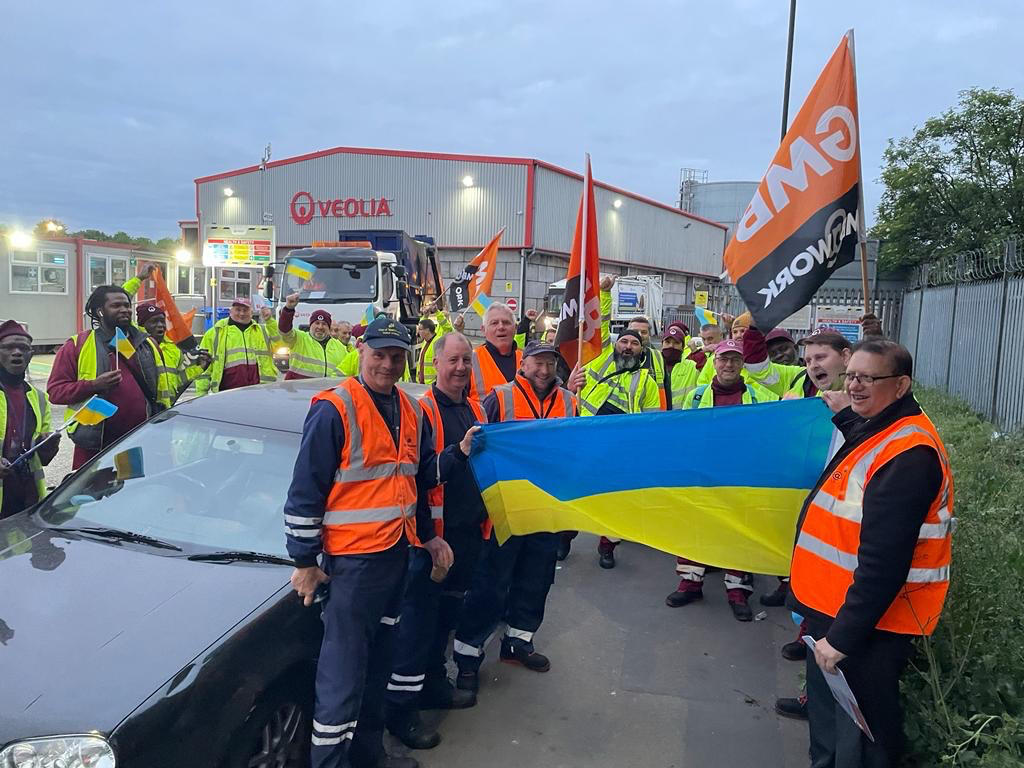
In fact, we are a small group that has managed to keep Ukraine on the agenda while building direct links between the Labour Party and the unions. We have mobilized campaigns and framed the war as an anti-imperialist and anti-fascist struggle, effectively bridging practical aid with political campaigning. I believe this work was essential; without it, the situation in the UK could have been very different, as we saw in the aftermath of Euromaidan. We must also remember that there are sections of the capitalist class — both in Germany and the UK — who want “peace at any price” with Russia. When our internal divisions multiply, it only strengthens their position and helps them undermine our efforts. I know comrades in Germany who now regret that they didn’t launch similar campaigns — like the USC — in their own country years ago.
Usually, it is easier to have a discussion with workers than with those factions of the left that do not support Ukraine and oppose military aid. Personally, I find it very difficult because, having been in Ukraine during this war, I see the direct consequences of their sabotage. By opposing aid and actively trying to block it, they are, in effect, helping Russia win the war. We see what happens when the aid stops: the attacks intensify. During the period when Trump blocked aid to Ukraine, more people were killed. I knew people who are dead now — people I had actually met. Their deaths are, at least in part, a consequence of the halt in aid and intelligence sharing, which disrupted early warning systems for air attacks. So, yes, it is difficult to have a dialogue. But that doesn’t mean we should avoid the debate. There is an ongoing struggle within the labour movement, and we are currently focused on how to navigate the argument over rearmament.
There are people who are genuinely opposed to spending money on rearmament rather than on welfare and public services. Of course, that is a somewhat simplistic view, as that money wasn’t exactly being poured into public services before the rearmament began. Nevertheless, while some address this as a legitimate critique of government priorities, others exploit the issue specifically to undermine support for Ukraine. We have sought to argue that the debate over defense spending versus social spending should not be centered on Ukraine; these two needs should not be counterposed. Some of the British trade unions that support us view rearmament as an indispensable policy for two reasons: first, it creates skilled jobs in weapons production for their members; and second, they believe we must arm ourselves to resist authoritarianism. Other supporters of ours disagree with this stance, believing funds should be prioritized elsewhere — yet they remain steadfast in their support for Ukraine.
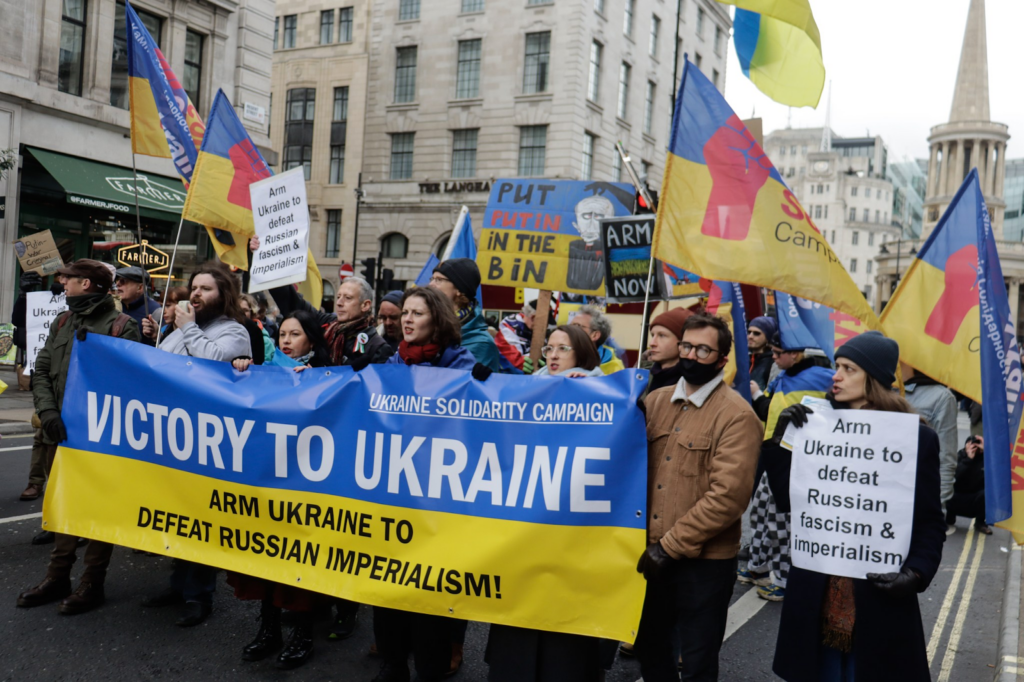
Recently, we joined another anti-fascist demonstration in London. We brought Ukrainian flags, and though we were a bit nervous about how people would react, the response was positive — actually, it was very encouraging. We even met some Ukrainians there, which has inspired us to do more of this. We want to maintain a consistent Ukrainian presence at such events, specifically to link the fight against fascism directly to the Ukrainian struggle.
We also participated in the massive anti-Trump demonstration during his visit to London in September 2025. Our presence was part of a broader coalition that included even our direct adversaries, such as the Stop the War Coalition and the Communist Party of Britain. Naturally, we felt some anxiety, but we ended up forming a dedicated Ukrainian bloc with a massive banner and dozens of Ukrainian flags. Remarkably, people we didn’t even know traveled from across England just to join us — individuals who had been active in aid and volunteer work but weren’t previously linked to our campaign. This proved there is significant untapped potential. It showed us that there is no space where we should hesitate to intervene or participate.
Solidarity campaigns are not only about humanitarian aid. It is much more difficult to encourage people toward political solidarity. You mentioned that the people with whom you work have changed somehow — British trade unionists and British leftists, and maybe Ukrainian trade unionists and the Ukrainian diaspora as well. I think most of our people from the trade unions whom you mentioned are not yet very politically conscious or active in defining and fighting for their political interests.
We need to be very conscious of the fact that you are in a post-Soviet political environment. In the British trade union movement, it is very common for trade union leaders and most members to automatically consider themselves to be within some shade of the left, or explicitly socialists. Many activists would identify as socialists or some form of social democrat, and they would certainly be aligned with the Labour Party. In fact, the majority of trade unions are affiliated with the Labour Party.
In Eastern Europe, Stalinist regimes destroyed the tradition of democratic left-wing politics. Combined with the complex history of Ukraine’s national question, this has created an environment where openly identifying as left-wing is far more difficult than in countries like Britain, where such language and identity are more established. Then there is also the complexity of political corruption. I think one of the most consistent findings in Ukrainian opinion polls is that almost no one trusts politicians. Consequently, there is a significant difference between the nature of trade unions and the labor movement in Ukraine compared to those in the UK.
I am not saying we should trust British politicians; we shouldn’t. The point is that people often mean the same things, but they do not use the same language in Ukraine as they do in Britain. This is quite tragic because many ideas of the dissidents and the first independent trade unions were so progressive and radical — even the early ideas of the Rukh were more radical and far ahead of what we see today. In terms of political alignments, it is vital that we develop a dialogue and shared knowledge to help progressive left forces in Ukraine grow. I hope that the political left can become broader in Ukraine and eventually unify into a broad social-democratic workers’ party. It is hopefully only a matter of time before trade unions in Ukraine evolve as they did in the West. At the end of the day, workers will not always be satisfied with just a trade union voice — they need a political voice too.
Regarding Ukrainian communities in the UK, there has certainly been an evolution. The generation of post-Euromaidan youth who arrived after the full-scale invasion is very different from the diaspora community that existed before. The post-WWII diaspora held a kind of political monopoly, and the arrival of Ukrainian refugees after 2022 created tensions. Young Ukrainians, particularly in London, have participated in Pride with Ukrainian flags, while others joined environmental marches with yellow-and-blue banners. This resulted in a scission, with many young people breaking away to set up their own organizations with more liberal, democratic, and progressive views on issues like LGBTQ+ rights and the environment — views that could no longer be reconciled with the older organizations. The Ukrainian community is evolving rapidly. These are people with different experiences, heritages, and political outlooks. Some are joining political parties: we now have Ukrainian activists in the Labour Party, including a high-profile anti-racist campaigner in Wales. We also have Ukrainian environmental activists in the Green Party. In fact, at the upcoming Green Party Conference, there is a motion in support of Ukraine. There will be a significant debate involving young Ukrainians who are members of the party, as well as supporters of the USC. We did not have that before.
For many years, the Ukrainian community in Britain did not engage in the country’s political life at all. This was a significant mistake, as Russians have always been deeply involved in British politics. The current evolution is a very positive development; while not every change is necessarily progressive, it demonstrates that since Euromaidan, a more liberal-democratic outlook has emerged — particularly among younger people — compared to the perspectives held by previous generations.
As for Ukraine, we tried to maintain a dialogue with various groups. Some of us were very supportive of, and advocated for, the establishment of Sotsialnyi Rukh in the aftermath of Euromaidan. In particular, Marko Bojcun and I felt very strongly that it would be beneficial if a new left-wing organization, closely linked to the revolution, emerged from Euromaidan. It was a very positive development when Sotsialnyi Rukh appeared, with its efforts to create a new workers’ party. I truly hope this can happen and civil society will evolve beyond the NGO model.
We also maintain a dialogue and links with SD Platform, who are very close to the Labour Party in the UK. There is always a space for left-wing forces in Ukraine, and we need to provide our support so they do not become isolated. Obviously, the “new left” in Ukraine is currently operating in a very difficult environment, and we do not know how things will develop. However, I believe it is vital to have a genuine dialogue with people inside Ukraine — whether they be soldiers, members of Sotsialnyi Rukh, or trade unionists. This should not be just for show, but based on actual joint work and shared objectives.
We did not only campaign for weapons; we consistently consulted with people to maintain a genuine dialogue. This was how we developed our platform to oppose both Trump and Putin, calling for an alternative to Russian occupation. We always want to hear from you — as part of Ukrainian progressive civil society — what you believe needs to be done. A number of our recent campaigns have resulted directly from these discussions and our visits to Ukraine. For example, regarding the kidnapped children: after meeting people in a refuge in Ukraine, we saw firsthand that this issue was not receiving enough attention here. Another critical moment was during Donald Trump’s visit to the UK. We felt a pressing need to focus more on the occupied territories, as there is currently almost no attention given to what is happening there. If an unjust “peace deal” forces a division and makes the occupation permanent, the world needs to know what that will mean for the millions trapped under Russian rule: kidnapping, torture, forced displacement, the seizure of housing, and life as a rightless beggar. This is why we must campaign in dialogue together. No one but us will write the history of the left-wing voices of resistance.
What does left-wing politics mean to you?
I will start with my core beliefs: we live in a class society, and there is a class struggle, although many people no longer wish to talk about it. Yet, we have a labor movement that was formed specifically to oppose the capitalist exploitation of workers. That is how workers first began to self-organize. So our natural allies in Ukraine must be the workers’ movement. Classes are in a state of permanent struggle, which inevitably leads to the fundamental debate: what kind of society do we want to create and live in?
And out of that, the concept of what a left policy should be emerges. We want to live in a society that is fit for human beings, where people who work are not just going to be bought and sold as commodities on a labor market and shouldn’t be viewed as just commodities. So left policy should start from a view that we don’t accept that, and that we want more. We want people to be treated as human beings, to realize their full human potential. And that could be applicable to miners in Donbas who can no longer work in a mine. They should be able to realize their potential and have alternative employment that’s humane and satisfying. The same concerns soldiers who may come back wounded.
I have been very influenced by the socialist humanists who emerged in the East and West as a reply to totalitarian communism and Western capitalism. These include the Ukrainian dissident Marxist humanists. For me, the lesson of the 20th century and the experiences of the Soviet period and those communist regimes is the centrality of human beings. The left project is also about overcoming alienation, with the human being at the center of it, as the subject and force for change. The power for change is not “from above” in that sense. So, left policies are twofold — there are the most immediate needs we must address in a minimum programme. In this context, we have immediate problems regarding our basic social needs: homes, wages we can live on, our environment, and the defense of democracy, especially in Europe. Ukraine is central in the context of rising authoritarianism; winning the war in Ukraine is vital to preserving democracy in Europe and opposing fascists in all our countries.
But there is as well a pushing back against the agenda that is just going to reduce Ukraine to an arena for exploitation, whether it be by global capital or Ukrainian oligarchs. So a left policy, both in Ukraine and outside, is one where we make solidarity with those struggles to defend working people from what is happening to them — from being just robbed and exploited under the name of reconstruction or peace. The space for left policy here is in collective solutions to wage issues, and in discussions of the right to housing and access to free and decent healthcare. These are the basic minimums where we have equality at work and equality in society.
At the same time, a left-wing policy has to have a larger goal. We need to recognize that the problems we face in the labor movement — whether in Ukraine, Europe, or globally — are not isolated, and we can’t necessarily deal with them all separately. It isn’t just about democracy; we want a social-democratic change. We need social change, and that means system change, transcending the system that is creating these Putins, Trumps, and oligarchs. We still need to look toward developing an emancipatory vision for a different type of society than that which existed in the 20th century, though we must learn from that too. There’s a disorientation inside the labor movement because our problems are so huge that immediate solutions often prompt us to lose sight of the fact that if we don’t change the system, we’re going to be back here again. Yes, we need an immediate left policy we need, but as well we need more than that.
I don’t think we should be romantic about it. We may be forced to form alliances with people we don’t agree with if we are eager to deal with this fascism and authoritarianism. Without this, it is going to be very difficult to create a better society. The national question hasn’t gone away, and I think it is very central: national emancipation is as important as social emancipation. This is exactly what Ivan Dziuba always argued: «The Ukrainian question was both social and national. It is impossible to focus on just one of them, and it is impossible to solve one without the other.» I come from a country where there’s a deep national question: my family originated from Ireland. I think that in countries which were former colonies, or where there’s a deep national question, you can’t build a socialist project or a left organization without keeping in mind the need for national liberation as well. I think that’s a lesson for Ukraine: every socialist project in the past in Ukraine that didn’t have national emancipation as a central part of it, or didn’t focus on overcoming the legacy of colonialism, failed in the face of more Russophile groups or, later, more conservative nationalist currents.
So, I think recent events have affirmed that point. You know, I remember having a discussion with someone from the Ukrainian left after Euromaidan who was telling me that I was stuck in the 1920s — that there was no longer a national question. But I think that’s a completely catastrophic mistake in the analysis of people like Volodymyr Ishchenko. Of course, there is a national question when nearly 20% of the country is occupied by the historical colonial power.
With so many wars and injustices in the world, how do you manage to keep attention focused on what is happening in Ukraine?
The war in Ukraine is pivotal to global developments. When Putin launched this invasion, it wasn’t just a regional conflict — it was an assault on global stability and the basic framework of international law. It is a counter-revolution on a grand scale. The longer the war continues, the more it erodes those norms. Russia has contributed to creating a “might makes right” world, where authoritarian powers dictate the rules. This dynamic emboldens others — Netanyahu’s actions are one example — pushing us toward a system where only the strongest decide what happens, without accountability. It is taking what Marx called the “battle of capitals” and intensifying it to extreme proportions.
It’s important to recognize that this war in Europe has profound consequences for democracy. The democratic institutions we have in Europe were won through generations of working-class struggle. If authoritarian and far-right forces succeed in undermining them — as Putin’s war aims to do — it threatens not only Europe but the entire world. If the core of global stability and liberal democracy collapses, hope for the rest of the world diminishes as well. Yes, European states are often hypocritical; they’ve colluded in atrocities like Gaza and exploited the Global South. But their democratic achievements still matter. Just as in the 1930s and 1940s, if Europe turns fully reactionary toward the populist far-right, it will benefit no one. That’s why the outcome of the war in Ukraine is critical, not only for Europe but for shaping the global order. It has far-reaching consequences. Other conflicts matter, but right now, Russia’s war in Ukraine is central and pivotal to the future of democracy and international stability.
If Ukraine wins, it would be a major defeat for the authoritarian project — not only for Putin but also for figures like Trump. This is central to the global struggle for democracy. Of course, this does not diminish the human cost and the suffering of the Ukrainian people, which remains paramount. We should absolutely support a ceasefire; however, that does not mean we — as the global left and workers’ movement — should support an unjust deal that makes partition and occupation permanent, thus rewarding Putin. We should be seeking to push Europe to create conditions for a different outcome for Ukraine, which Europe has the means of achieving.
Trump’s actions created confusion and slowed aid efforts, as many believed the war might soon end. That uncertainty has faded, but it affected fundraising and solidarity work. Ironically, other actions by Trump — such as his scandalous outburst toward Zelenskyy in the Oval Office — inspired some people to support Ukraine more actively. People saw that Trump and Putin seemed to have reached some kind of understanding, and that this arrangement served only their interests. One of our most visible actions at the time was a demonstration outside the U.S. Embassy together with Ukrainian groups — something I never imagined witnessing in my lifetime.
We are entering a new phase, both in the war and in our solidarity work. We must present Ukraine’s struggle as part of the global fight against fascism and authoritarianism, linking it to the challenges we face here in the UK. Far-right, anti-migrant forces are gaining ground; if we don’t stop them, nothing good will come of it. Supporting Ukraine is essential, and our messaging must adapt to reach broader audiences — this fight remains critically important not only for Ukraine, but for democracy worldwide.
You mentioned it took almost 10 years to convince six British trade unions to support Ukraine. We also see how difficult it is to persuade UN member states to take a stronger stand in defending a country under occupation. In this context, we often hear arguments claiming that we are entering an era of authoritarianism because democracies are not flexible enough. What do you think about this?
Chinese President Xi Jinping stated that the current era will be one of autocracies, claiming that democracies are supposedly not flexible enough. This argument is deeply reactionary. The rise of authoritarian and even fascist forces is not caused by the weakness of democracy, but by crises within capitalism itself. In particular, the crisis of the falling rate of profit and the financial crisis — often called the Great Recession — ignited the latest authoritarian turn.
Why is this happening? Capitalists want to extract more, while the development of democracy stipulates the redistribution of wealth and the expansion of social programs, which empower labor movements. Authoritarianism is one response to this crisis, driven by growing competition between states and protectionism. Different factions of the capitalist class in various countries have embraced authoritarianism as their strategy. In some countries, these factions are winning — most notably in the United States — and there is now a real danger they could come to power in the United Kingdom or even France. In the UK, this faction has already succeeded in pushing Brexit and could potentially form a government, which would be a disaster both for us and for Ukraine.
However, these authoritarian forces do not dominate everywhere; there are divisions within the ruling classes. In this struggle, it’s in our interest to side with those who defend democracy. Importantly, every faction that supports authoritarianism is actively trying to undermine Ukraine and opposes aid to it. They understand the stakes — and so should we.