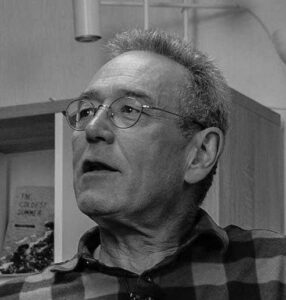
Maksym Kazakov: Hello, John! You are a very well-known historian in Ukraine, and every work or article you publish sparks lively discussion. People have very different opinions about you, but it would not be an exaggeration to say that you are a classic of both Ukrainian and Canadian historical scholarship. Anyone familiar with your biography might naturally ask: How did the 1960s shape you?
John-Paul Himka: First of all, thank you for inviting me to discuss these various issues with you. The 1960s were very important for me, especially 1969 and the early 1970s. At the time, I was studying at the University of Michigan. I became deeply involved in the anti-war movement. The Vietnam War was going on, and I took part in every demonstration held at the university. I also went to demonstrations in Detroit and Washington. We had our own small group of left-wing anti-war activists. I read a great deal of the literature of the time and collected left-wing newspapers. I first read Marx in the 1970s. These events shaped our entire generation. Some people later became indifferent to all of it. The most important things I took away from that period were the ideas of non-violence, the desire for a better social order, and hope for a better future. I have tried to live by those principles ever since.
MK: Did young people in the Ukrainian diaspora join the movements of the 1960s in large numbers?
JPH: Yes. At the time, I was living in the United States, throughout the 1960s and into the early 1970s. In Canada, there was a left-wing movement with a socialist orientation, connected to the Trotskyists, as well as an anti-Stalinist movement opposed to the Soviet Union. Of course, they did not have the war that we had in America. But they raised the issue of Ukrainian political prisoners in the Soviet Union and organised demonstrations. They also published left-wing magazines. The first was the English-language Meta (Goal), edited by Chrystia Chomiak (the wife of John-Paul Himka—Ed.), followed later by the Ukrainian-language journal Diyaloh (Dialogue). I was not closely acquainted with these people because I lived in the United States while they were in Canada, but from time to time, when I visited Canada, I would meet them at conferences.
There was somewhat less of this in the United States, but there was one group in New York called New Directions. They published a bilingual magazine. The movement was perhaps not really left-wing, but more liberal. Still, within the Ukrainian diaspora, it was revolutionary. I was somewhat involved with the group and wrote for them. I lived in Michigan, while they were based in New York. Their editors were Oleh Ilnytzkyj, Adrian Karatnycky, and Alexander Motyl. Both of these left-wing groups brought together intellectuals who would later become very important figures in the diaspora. Eventually, they went their separate ways. For everyone involved, it was a school of politics, journalism, and debate. It was a very lively time. We were completely absorbed in social and political issues, but later young people became less interested in them. As a university professor, I often interacted with young people and could see that they were not as concerned about these issues as we had been at their age when we were 20 or 25. At that time, we were deeply engaged, while they seemed almost indifferent to everything.
MK: Your generation was part of the “Sixtiers.” This was also a defining phenomenon in Ukrainian history.
JPH: Yes, it was happening all over the world, and Ukraine was no exception. We read Dziuba, Moroz, and others. We were particularly drawn to Dziuba and Internationalism or Russification?, but we read all of them and campaigned for their freedom. We thought we could change the world, change the system. I think this was something we had in common with young Ukrainians such as Nadia Svitlychna, Ivan Svitlychny, Drach, and Pavlychko. They believed they could change everything, that there would be a better future for everyone, and we thought the same. And then, as they say, things turned out the way they always do.
MK: Did you try to establish contact with the dissidents? Or was that simply impossible under the conditions at the time, before perestroika (restructuring)?
JPH: In the 1970s and 1980s, we sent Ukrainian-language literature to Ukraine. Through intermediaries, we had some very distant contact with those people. But we were not like the OUN (Organisation of Ukrainian Nationalists). Do you remember Yaroslav Dobosh? He was Ukrainian, or rather Belgian of Ukrainian descent, and someone in England gave him a list of various writers, dissidents, and others. The KGB (Committee for State Security) was following him, and he was arrested in 1972. We did nothing like that. But we had good connections with Ukrainian circles in Poland, and we constantly supplied them with Ukrainian literature: our own publications, publications by Proloh in New York, and those by Smoloskyp. But it was in the 1980s that we first established closer contacts. I remember being in Lviv in 1989 and meeting Viacheslav Chornovil, Ivan Kandyba, who had just been released from prison, and Mykhailo Osadchy, whom I had enormous respect for because of his literary work. We had to wait for perestroika before we could really speak openly. But even earlier, I had spoken with people on the “periphery” of the dissident movement. In 1983, for example, I met Yaroslav Dashkevych, who was also in opposition.
MK: You worked in Soviet archives. How did you manage to get access, and what did you research there?
JPH: There was and still is an organisation called IREX, the International Research & Exchanges Board. Researchers from the Soviet Union came to America, while we had the opportunity to send our doctoral students to Russia and Ukraine, mostly to Russia. It was a regular and mutually beneficial exchange programme. The Soviet Union mainly sent engineers and natural scientists, while America sent literary scholars, historians, and people from the humanities. A wide range of people took part. I wanted to write my doctoral dissertation on the socialist movement in Galicia and to work in Poland and Ukraine, because Kraków and Lviv are both part of Galicia, at least in the historical Austrian sense. The first year I applied, the Soviet Union simply turned me down, but I was given the opportunity to spend a year working in Poland. That was extremely important for me because the local libraries had Galician periodicals, as well as archives on the history of the socialist movement, particularly the movement in Kraków itself. I learned a great deal there.
Then I applied again, and the American authorities put pressure on the Soviet Union to accept all the candidates. The American committee believed that I should be able to work in Lviv, as I wanted. So in 1975–76, the Soviet Union finally accepted me, but I was supposed to be in Leningrad. That is where I did most of my work. What was particularly interesting for me was that they had all of Drahomanov’s works in the Saltykov-Shchedrin Library (now the National Library of Russia—Ed.). So I had plenty to work on. I was also fascinated by everyday life in the Soviet Union. This was a bit of a digression, but let me tell you… When we were in Poland, the locals were constantly complaining that there was no meat. We did eat meat, of course, but everyone kept complaining that the Soviet Union was taking their meat away, which was why there was so little of it. (laughs) I thought that when I arrived in Leningrad, there would be plenty of meat products there. But I was surprised by how poor a country the Soviet Union actually was. Supposedly, it had “stolen” everything from everyone else, yet people were living just as poorly as—compared with the Poles at the time—they were.
I found it interesting even to be in Leningrad, although the winters there were harsh. But I really wanted to get to Lviv and Kyiv because I knew they had the materials I needed. In February or March 1976, I was finally allowed to spend a month in Lviv and a month in Kyiv. Lviv was wonderful. I had access to the archives and the library, and I worked in the university library, which had all the Galician publications dating back to the 19th century, exactly what I was interested in. I was able to work without any restrictions. Whatever I requested, they gave me. I don’t know whether this was some kind of official policy. I doubt it. There were these elderly ladies working there who simply kept bringing me whatever I asked for.
As for the archives at the time, I did not have access to the finding aids. I had to request the exact reference code for whatever I wanted to see, but I was not allowed to browse the finding aids themselves. Fortunately, I had prepared for this in advance. When I was reading about Galicia in Soviet publications, I kept a card index: this number, this collection, this file—all relevant to the subject. I had hundreds of these cards and was ready to order a great deal of material. Also, whenever I went out for a cigarette and other researchers were returning their archival files, I would look at the collection number and title and write them down. That way, I could order quite a lot. I used all of this for my doctoral dissertation and my first monograph, so I was very pleased with it.
From Lviv, I was supposed to spend a month in Kyiv. I was met very coldly there. They even told me to go back to Leningrad because they would not accept me. This was 1976. For me, as an American citizen, buying a ticket from Kyiv to Leningrad was almost impossible. Today I can just book a ticket online. Back then, I had no idea what to do. They refused to give me a place to stay and simply threw me out of the university. When I walked out, I was desperate. Completely by chance, I ran into my academic supervisor from Lviv, Professor Denys Nyzovyi. He listened to my problem and said I should contact the Ministry of Education. I followed his advice, and the ministry pressured the university into giving me a place in a dormitory. That chance encounter saved me. Then they refused me access to the archives and even to the library. But Mykola Zhulynsky came to my rescue. At the time, he was the director of the Institute of Literature, which held the entire correspondence of Ivan Franko, very important material for the history of the socialist movement. Serhii Plokhii (or his assistant) later found a document in the archives in which Kyiv University described my stay in Ukraine in 1976. Apparently, I was a CIA agent who was trying to get in touch with OUN members in Kyiv, but they had managed to neutralize me. (laughs) I find this document very funny. In 1983, I had another opportunity to work in Lviv for six months and, I believe, for a month or a few weeks in Kyiv. Once again, they would not give me access to anything in Kyiv. But I spent that time very peacefully with my wife in Hydropark: we lay on the beach, ate chicken, drank wine and beer. It was nice.
And there is one more interesting detail. I did most of my work at the Central State Historical Archives in Lviv, which at the time was headed by Nadiia Vradii, Vika’s mother… You know that singer? She was initially with Braty Hadiukiny and later released albums of her own. Her mother was the director of the archives. I would not say that she did a great deal for me, but in situations like that, it is good when someone simply acts like a human being rather than a pig. She was a human being.
MK: You initially worked on the history of 19th-century Galicia, and later turned to the OUN, the UPA (Ukrainian Insurgent Army), and the Second World War. When did that happen, and how did you begin to reassess these organisations critically and those events more broadly?
JPH: I had been collecting material on Ukrainian-Jewish relations for a long time. Even in my earliest books, you will find a great deal on this subject. The Holocaust also interested me to some extent. You could say that until the end of the 1980s, I accepted the view that prevailed in our circles. And that view was… Oh! There is Diyaloh, I see. (Gets up and takes a copy of the journal from the shelf.) We published this and sent it to Ukraine. So, I accepted this view, which went something like this: it was true that the OUN initially had an alliance with the Germans and welcomed them. But very soon, as soon as the Germans refused to recognise them, they went into opposition. The OUN marching groups that went into eastern Ukraine encountered Soviet people who demanded a progressive social programme from them. Then they shed their fascist shell! This was essentially a popular uprising that had nothing to do with the OUN or pro-German sentiments. They were democrats fighting against both totalitarian regimes. I swallowed that whole, just like everyone else in our circles. I even thought it was a great tragedy that the UPA emerged only after the Jewish Holocaust had ended in the spring of 1943, when most Ukrainian Jews had already been killed. I thought that if the UPA had been there earlier, those democratic and tolerant people would have saved Ukrainian Jews from the Nazis. I genuinely believed all of this.
But what happened? In 1988, I was corresponding with a Polish historian, Janusz Radziejowski. He had written a book about the Communist Party of Western Ukraine, which was published in both English and Polish. He was a close friend of mine. We became close when I spent a year working in Poland. Later, he lived in Edmonton for a year. We corresponded constantly and shared many academic interests. I don’t remember exactly how it started, but in 1988, we began arguing about the UPA. “How can you, a man that holds left-wing views, respect people who killed so many Poles and Jews?” Janusz wrote to me very sharply. I no longer have my letters to him, only his replies. But I remember being outraged and writing back everything I have just told you about the UPA as democrats and about all the positive things they had done. Janusz asked me to list those positive things. I said they had fought very bravely against both the Germans and the Soviet Union. He replied that if we were talking only about bravery, then a German soldier should be called very brave too, because he had fought and won for a long time against both the Allies and the Soviet Union. Janusz said that bravery was not what defined a political movement; what mattered was its ideology and its conduct. I had enormous respect for this man, so I decided that I had to investigate the issue myself. I needed to find out what had actually happened during the Holocaust.
My father-in-law, Mykhailo Chomiak, died in 1984. During the Second World War, he had been the editor of the German occupation authorities’ Ukrainian-language newspaper Krakivs’ki Visti (Krakow News). When I decided to investigate for myself and at least find my own answer to the question of what Ukrainian nationalists had actually done during the Second World War, all of his documentary materials had just been transferred to the provincial archives. There were all the editorial papers, correspondence—everything related to the newspaper. It was probably the most complete archive of any Ukrainian-language newspaper published under the occupation and, most likely, the most complete archive of any newspaper published during the occupation in the General Government, the territory of former Poland. My father-in-law had also collected other publications from that period. It was an enormous collection of sources, an archive that no one had ever looked at before. I began working there and studying the correspondence. The Germans had commissioned a series of antisemitic articles, and there was correspondence between the editorial office and the antisemitic authors. That became my first research project in the late 1980s and early 1990s. Then, in 1995, the journal Studies in Contemporary Jewry invited me to write an article about Ukrainians and Jews during the Holocaust, or rather, about Ukrainian collaboration. They invited me because the editor had read my articles, including my work on Jewish-Ukrainian antagonism in the 19th-century Galician village. He considered my work balanced, so he specifically asked me to contribute. I received funding to spend a week working at the YIVO Institute for Jewish Research in New York. Even better, my university gave me funding to spend a week in Jerusalem at Yad Vashem. But I couldn’t stay any longer. Those were the conditions of the fellowship I had: I could not be away for more than one or two weeks. I encountered new sources there and began to understand much more about the nationalists, although many things still remained unclear. That same year, in 1995, I was finishing my monograph on the Greek Catholic Church in Galicia, and it was time to choose a new research topic. I thought, enough with 19th-century Galicia. My grandfathers had left Galicia, and I needed to follow their example. I needed to “leave” Galicia too. I thought about it, read, considered different options… At first, I thought about writing on the Holocaust. But at the time, the subject didn’t seem particularly relevant: Ukraine was now free, moving toward democracy, and this history was no longer really needed. Ukrainians could study it themselves. I also thought the diaspora was slowly disappearing because no one was getting involved and there were no young people. I was wrong on both counts. I was also wrong to think that the subject was not intellectually interesting. Instead of writing about the Holocaust, I began researching the iconography of the Last Judgment in Galicia and Transcarpathia. I wrote one and a half books on the subject: one on my own and the other co-authored with Liliya Berezhna.
So, in 2006, I finished that project and started thinking about what to do next. I came to Lviv to give lectures as part of the Soros programme. I saw posters everywhere commemorating the Act of June 30, 1941, along with portraits of Shukhevych. By that time, I already understood that there were serious problems with the nationalists. I thought that someone had to address this subject. And it would be better if I did it as someone with a deep sympathy for and love of Ukraine, rather than some biased historian. I had no idea how much trouble this subject would cause me or how strained my relationships with other colleagues would become. Once I decided to work on it, I had the opportunity to spend three months at the Holocaust Museum in Washington, where there were excellent materials. By early 2010, I had a fairly clear understanding of the history of the OUN, UPA, and Jews during the Holocaust. When Yushchenko made Bandera a Hero of Ukraine, the controversy began. Since then, I have kept writing about these issues. I still have to write one more monograph because this subject continues to haunt me.
MK: There was a Soviet stereotype of the OUN’s “bourgeois nationalism”, an obvious political label. In the Soviet Union, even people like Skrypnyk and Khvylovy could be called bourgeois nationalists. From a scholarly perspective, what was the class basis of Ukrainian nationalism, both in the form of the OUN in the 1930s, with its political activists, and in the more mass movement of the UPA?
JPH: The OUN was founded by intellectuals, veterans of the First World War, the revolution, and the struggle for Ukrainian independence, as well as by students. It was the intelligentsia that gave birth to the OUN. It was a movement that came from the top down, rather than a grassroots movement. But they were very effective at mobilising the peasantry and the small Ukrainian working class. I am currently working at the Stefanyk Library in Lviv, reading an OUN newspaper for peasants, the weekly called Nove Selo (New village). Each issue is ten pages long. In some respects, the newspaper is very similar to the populist newspapers for peasants: letters from villages, economic information, and always one large page with very sensible advice about what people should do depending on the time of year. But there was also a great deal of politics: pro-German, pro-Italian, pro-Japanese, anti-democratic, and antisemitic politics. That was how they mobilised the peasants. The nationalists had a similar newspaper for the working class as well. Life in the countryside was difficult in those days. Still, agriculture across Europe, Canada, and America was going through an economic depression in the 1930s. Agricultural prices were low, and farmers and peasants were not doing well. Those who owned more land were often migrants, people who had spent some time in America. They had previously worked for years in mines or shops and saved enough money to buy land. But I don’t think that support for or opposition to the OUN had any direct connection to the class position of those peasants. In general, our peasants were not particularly wealthy. One generation might be better off, while the next would be poorer. That was the case, for example, with my grandmother’s family. She emigrated to America in 1909. She left because her family was so poor that she couldn’t find a husband. No one wanted to marry my grandmother. There was only one family in the village that was poorer than hers, and she didn’t want to marry into that family either. So she went to America, where she found a husband and started a family. Her younger brother also emigrated, but later returned with his savings and bought a great deal of land. That is how a poor family became one of the wealthiest in the village. Then the Soviet authorities came. Immediately after independence, they were also doing quite well by the standards of the 1990s. Her husband worked in the collective farm administration, so they had access to seeds, fertiliser, and machinery. But he died, that generation passed away, and the next generation no longer had access to them. They work hard, but they are poor. So, it’s poverty, wealth, and then poverty again. Such cycles occur among peasants everywhere. There is no group of peasants that remains wealthy permanently. It can happen occasionally, but in general, it is a cyclical process.
MK: Which researchers on the OUN-UPA would you recommend? Who can help us get closer to an objective understanding of the truth, as far as it can be understood, while avoiding the stereotypes of both Soviet and pro-OUN propaganda?
JPH: The works of Marco Carynnyk are very good. He mainly writes about the OUN, rather than the UPA. His work is probably the most solid research on the subject. We shouldn’t think of history as a closed process. There are different voices. On the one hand, there are scholars such as Grzegorz Rossoliński-Liebe, Per Anders Rudling, and Delphine Bechtel, who may be completely critical of the OUN and UPA. Others, such as Grzegorz Motyka, Dieter Pohl, and other scholars, are more ambiguous in their research for different reasons. I think we should read all of them, but think through and form our own view. Obviously, the most objective of them all is me. (laughs)
MK: It seems to me that we should acknowledge that certain actions were crimes by the standards of the law and morality of the time, while at the same time trying to understand the objective reasons why powerful nationalist movements emerged.
JPH: But what were the objective reasons for the Nazis murdering their victims? Or the Stalinists? I don’t think there are always objective reasons. The “objective” reasons existed in their heads. Our nationalists believed that Ukraine without non-Ukrainians would be a Promised Land for Ukrainians. But to achieve that, as the Germans also thought, one generation would have to do the bloody work, so that no one after them would have to grieve over it. To some extent, that was their ideal. But the Nazis, who murdered almost all of Ukraine’s Jews, or at least a very large proportion of them, and the Stalinists, who deported almost all the Poles, Tatars, and other ethnic groups from Ukraine, ultimately fulfilled the nationalists’ dream. And none of them (the Nazis, the Stalinists, or the nationalists) were particular about the means they used to achieve it. They murdered people and drove them from their homes. Of course, the nationalists didn’t have trains to deport people, so they wanted to use terror and intimidation to force families who might have lived there for centuries to leave Ukraine and move to Poland.
“There are no heroes: there are people who teach us, and people who have nothing to teach us.”
MK: What do you think about historical policy in Ukraine, which has been actively pursued in recent years? Should there be a deliberate state policy toward history in the modern world? And can there still be heroes today—figures from the past who are presented as role models for people today?
JPH: I think the politics of history is a disease shared by all post-communist countries. There is no historical policy in Canada or America. Many developed countries simply don’t have one. As for the heroes who are an essential part of the historical politics of post-communist countries, I think this is simply infantilism. A childish disease. Why do we need heroes? Take Sheptytsky, for example. He was a fascinating and deeply thoughtful person. But we can’t say, “Oh, everything he did was wonderful, it was all heroic.” Even saints are not as saintly as we imagine them to be. Take Saint Peter, who was the leader of the apostles. In the Gospel, Christ wanted him to walk on water, but Peter hesitated, lacked faith, and began to sink. Peter denied Christ three times. And this is the foremost of the saints. What are we supposed to say about the other saints? That we must believe they were flawless? That we cannot think about them or talk about them at all? What applies in the religious sphere applies in politics as well. There are no heroes. There are people who teach us, and people who have nothing to teach us.
I work and do the best I can. But I have many faults, both in my work and in my life. I know that. I am aware of it. I am far from perfect. So why should I imagine that other people are heroes, like Superman or Batman? They are not heroes. They are people. I don’t think we can really learn anything from Bandera, because I don’t think he actually did anything. But even reading Stetsko, who at least thought about things, or Dontsov and others, there are things we can learn from them. But that doesn’t mean they were positive figures overall. I’ve read Mein Kampf twice. I can’t simply dismiss it as an intellectual mess. There are ideas in it. We need to think about everything.
People keep telling me, “If the UPA and the OUN aren’t heroes, then who are our heroes?” I say, “Grow up!” How would you say that in Ukrainian? “You need to grow up! You need to act like adults!”
MK: Perhaps that is the most important thing history can give society—teaching people to think for themselves.
JPH: Just like literature! We read fiction, novels, to enter into other people’s worlds and experiences. We see the same thing in history.
MK: What place does Marxism occupy in academic scholarship in North America today?
JPH: There are Marxists; perhaps not as many as there used to be, but they are still around. There are also post-Marxists, some good Marxist analysts. The Marxist geographer David Harvey, for example, writes very interestingly. He is highly respected because he genuinely has a lot to say. The main problem with Marxism in Ukraine is that when Ukraine encountered Marxism, it was Soviet Marxism, and from the 1930s onwards, that wasn’t intellectually interesting. Instead of being a way of understanding the world, it became a way of not understanding the world, of hiding the realities of the world from people. So it will probably be difficult here. But there were good Ukrainian Marxists. I think that one day we should translate all of Roman Rosdolsky’s works. He was a good Marxist theorist and a brilliant social historian. Once you discover that other side of Marxism, you can see that it is not simply some kind of “opium of the people,” but genuinely a way, a concept of understanding the world. But it has to be approached at a serious level, not a simplistic one.
MK: What research are you working on now? What can your readers expect from you in the near future?
JPH: I have to finish my monograph on the OUN, the UPA, and the Holocaust. When I started working on the Holocaust, I knew from personal experience that it was an extremely difficult subject. It is very hard to keep reading and thinking about all of it. I actually had nightmares about those terrible events more than once. So I decided I needed to work on something else alongside it, something that would make it a little easier for me emotionally. Together with two other scholars and my daughter, we are photographing all the Ukrainian churches in the provinces of Alberta and Saskatchewan. In each church, we take around 500 photographs: the icons, all the buildings from different angles, every piece of church equipment, and the books used in services. We expect to finish the photographic documentation next year. There will be half a million photographs, all indexed in a database. These churches are under threat. Every year there are fewer parishioners, and those parishioners are getting older. Every year, more and more money is needed to keep a church going. These churches are disappearing. We are documenting what they look like today. We started the project in 2007. The planning took a great deal of time, and since 2009, we have spent every summer photographing churches. It is an enormous amount of work. We don’t have much money, so we do everything on a shoestring budget. The four of us, three scholars and my daughter, travel around Canada. We don’t eat in restaurants or cafés; we eat in our hotel. We stay in very cheap hotels and spend the whole time battling ticks. But it is incredibly interesting work. Once we have collected everything, I plan to write a book about the development of icon painting in Ukrainian churches in Canada. I am almost ready to start writing, but I am still gathering information about who painted what and where. Every art form has its own history. That is what interests me. I’m not an art historian, so I can’t look at a particular work and say with certainty, “Oh, this icon was painted by such-and-such an artist.” I will be working with art historians in Lviv. But I can understand the process much better than art historians can. As a historian, I can interpret all of this and turn that chaos into some kind of narrative. We see this project as our gift to future generations. It will be a huge collection of sources that can be used to research all kinds of subjects we haven’t even thought of yet.
“Religion is like a hammer: you can use it to build, or you can use that hammer to kill someone.”
MK: Are these churches Greek Catholic?
JPH: There are Greek Catholic churches, Orthodox churches, and even Baptist ones. There are Orthodox churches under the Moscow Patriarchate, but they hold services in Ukrainian and, for example, have priests from Lviv. In general, they are very patriotic. I belong to the Ukrainian Orthodox Church of Canada. There is also a separate Bukovinian Orthodox jurisdiction. And there is the Orthodox Church in America, which has parishes in Western Canada. This year, we visited a Kyiv Patriarchate church. My brother-in-law has a summerhouse near Kyiv, and there are two churches there. There used to be just one, but after Euromaidan, a Kyiv Patriarchate church appeared as well. We don’t know where the money for it came from. It is the same in Canada: people argue, establish their own church, and build it. People think Ukrainians are very religious and devout, so they must have so many churches. But, in fact, it is like that old Jewish joke: there have to be two synagogues—one to go to, and another whose threshold you would never cross. Religion is like a hammer: you can use it to build, or you can use that hammer to kill someone.
MK: How much has the Ukrainian diaspora changed over the past few decades? Is it becoming absorbed into Canadian society?
JPH: It used to be more diverse than it is today. There were more political movements and tendencies. There were even communist organisations, liberals, and right-wing radicals. Today, I would say the Banderites are stronger than they used to be. Once, they were just one party among many. That diversity is gone now: there is no Ukrainian left, no communists. There are no two different views of Ukraine anymore; almost everyone thinks more or less the same way. Newly arrived Ukrainians make a big difference—they are breathing new life into the diaspora. They have their own organisations, sometimes their own churches, and they maintain a certain connection with Ukraine.
I live in a housing cooperative. We founded it as a Ukrainian socialist feminist cooperative. There is no private ownership. Of the 21 homes in the cooperative, four or five are inhabited by people who recently arrived from Ukraine. They contribute a great deal to the work we do in the cooperative. They are bringing the Ukrainian spirit back to the cooperative and are doing a very good job. There are even two Ukrainian gay couples. It is easier for them to live in our cooperative than in Lviv or Kyiv. Some of the houses have their own yards; some people have a large communal yard or have homes with two entrances. Canada is not Europe; we have plenty of space to spread out. What we created has worked very well. My wife was one of the key founders of our cooperative, as was the late Halyna Freeland (Chrystia Chomiak’s sister and Chrystia Freeland’s mother, Canada’s Minister of Foreign Affairs—Ed.), who once worked at the Ukrainian Legal Foundation.
MK: Thank you, John. Come to Ukraine more often!
JPH: And thank you for the interview.